TRUCKING · OWNER-OPERATORS
Owner-operator bookkeeping,
a system you can keep from the cab.
An owner-operator should keep books every week: one business bank account, every settlement booked at its gross amount with each deduction as its own expense, fuel receipts kept for IFTA, and the bank account reconciled to its statement each month. ZeraBooks gives you software to do it yourself from $79 a month, or our team does it from $150.
Free call · done for you from $150 a month (USD) · or keep the books yourself on ZeraBooks
BEFORE THE FIRST WEEK
What does an owner-operator need to set up first?
Most messy trucking books start with one account doing every job. Fix that first and the weekly work gets short.
A business checking account
Settlements go in, truck costs go out, and you pay yourself a set amount by transfer. Groceries and the mortgage never touch it.
One card for the truck
A business card or the fuel card for everything on the road. A personal card used for a tire once is fine; write it down the same day.
A short chart of accounts
Freight revenue, fuel, repairs and tires, insurance, truck loan interest, permits and licenses, tolls, phone and ELD, and escrow as an asset. Start with ten accounts, not sixty.
A folder for each week
Paper or phone, one place per week for the settlement, fuel receipts and anything you paid outside the settlement. That folder is what your bookkeeper, your accountant or an auditor will ask for.
Tell us about your books. We’ll scope the work and quote it before anything starts.
EVERY WEEK
What should an owner-operator do every week?
About 20 minutes, usually the day the settlement arrives. Skipping a week is fine. Skipping a quarter is how people end up paying for catch-up work.
| Step | What to do | Why it matters |
|---|---|---|
| 1. Save the settlement | Download it as a PDF and put it in that week’s folder | It is the only document that shows your gross pay and every deduction |
| 2. Book it gross | Linehaul and fuel surcharge as revenue, each deduction as its own expense, escrow as an asset | Booking only the deposit hides your real revenue and most of your costs |
| 3. Match the deposit | Check that the net on the settlement is the amount that hit the bank | Catches a missed load, a double charge or a settlement that never arrived |
| 4. Log fuel outside the settlement | Receipts for fuel you bought yourself, with state and gallons | IFTA needs fuel by state, not just a dollar total |
| 5. Move your pay | Transfer what you pay yourself, plus a set-aside for tax | Keeps owner pay out of expenses and leaves money for quarterly estimates |
Once a month, reconcile the business account and card to their statements. Our guide to bookkeeping for trucking shows a full settlement booked line by line, and the trucking bookkeeping checklist lists the month-end steps.
WORKED EXAMPLE
How do you work out your cost per mile from your books?
Cost per mile is the number that tells you which loads to take. Ridgeway Transport is a fictional one-truck owner-operator. In September 2026 its ELD showed 9,800 miles and its settlements paid $22,050 gross, which is $2.25 a mile.
| Cost from the books | September | Per mile |
|---|---|---|
| Fuel | 6,370.00 | 0.650 |
| Insurance | 1,480.00 | 0.151 |
| Maintenance and tires | 1,150.00 | 0.117 |
| Truck loan interest | 610.00 | 0.062 |
| Permits, plates and Form 2290 set-aside | 420.00 | 0.043 |
| ELD and phone | 95.00 | 0.010 |
| Total cost | 10,125.00 | 1.033 |
At $2.25 a mile coming in and $1.03 going out, Ridgeway keeps about $1.22 a mile, or $11,925 for the month, before depreciation, owner pay and income tax. Only the interest part of the truck payment is a cost; the principal pays down the loan. See how to record loan payments for the split. A rate below your cost per mile loses money however many miles you run.
RECORDS
What records should an owner-operator keep, and for how long?
The IRS says to keep records for 3 years in the usual case, and employment tax records for at least 4. Many accountants tell truckers to keep everything longer, and truck purchase papers for as long as you own the truck.
Settlement statements
Every week. They prove revenue and most deductions in one document.
Fuel receipts and fuel card statements
With date, state and gallons. Your IFTA return is built from these and your ELD miles, and your base jurisdiction sets how long it wants them kept.
Truck and trailer papers
Purchase agreements, loan statements and the lender’s year-end interest figure. Depreciation and the loan balance both come from them.
Logs or ELD reports
Days away from home support the per diem deduction, and miles by state support IFTA and IRP.
Bank and card statements
Every month, for every account the business uses. They are what your books are proven against.
SOFTWARE OR A BOOKKEEPER
Should an owner-operator do their own books?
If you have one truck, one carrier and 20 minutes a week, you can. ZeraBooks AI bookkeeping reads your bank and card statements, categorizes them from your past choices and checks every month against the statement, from $79 a month billed annually. If you would rather drive and hand it over, ZeraBooks bookkeeping services keep owner-operator books from $150 a month, quoted after a free call.
Book the free callCan an owner-operator keep books in a spreadsheet?
Yes, if you book settlements gross and reconcile to the bank each month. Most spreadsheets fail on the second part: nothing checks that the rows add up to the statement balance. Software that proves each month against the statement removes that risk.
Is bookkeeping different if I run under my own authority?
Yes. Leased-on drivers get one settlement from the carrier with deductions taken out. With your own authority you invoice brokers or shippers, chase payments or factor invoices, and pay insurance and permits yourself, so you also track receivables and factoring fees.
Do I record per diem in my books?
No. Per diem is a tax calculation from your days away from home. The books record what you actually spent; your accountant applies the rate. The current rates are on our bookkeeping for trucking page.
Does ZeraBooks connect to my bank or fuel card?
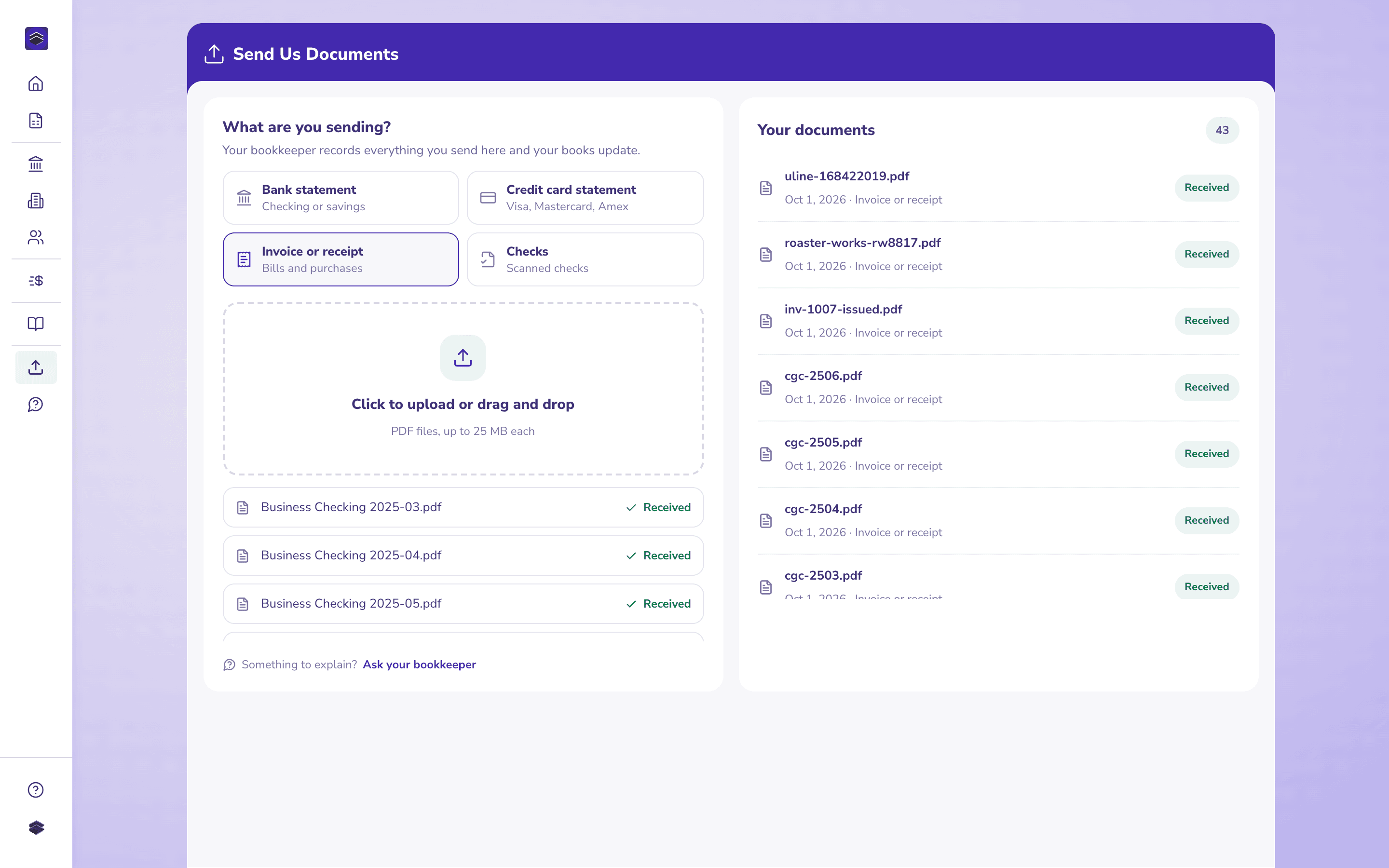
No. ZeraBooks has no bank, fuel card or ELD connection. You upload the monthly statements as PDF or CSV and every one is checked against its own opening and closing balance.
I’m months behind. Where do I start?
With the last month you trust. Gather every settlement and statement since then and work forward one month at a time, or have it done as catch-up bookkeeping, quoted once on top of the monthly fee.
WE DO YOUR BOOKS
Keep driving.
We’ll keep the books.
Settlements, fuel cards and the truck loan, booked every month from $150 (USD), with a read-only login and an upload portal. Book the free call.
Last updated November 4, 2026 · Written by Damin Mutti, founder of ZeraBooks