How to do a bank reconciliation, with a month that has every kind of difference.
To do a bank reconciliation, adjust the bank statement’s closing balance for deposits in transit and outstanding checks, adjust the ledger balance for fees, interest and errors the bank caught, and confirm the two adjusted balances are equal. Then record the book-side items as journal entries. AI bookkeeping software can do the matching, but the method is the same.
7-day free trial · card required, nothing charged for 7 days · then $79/month billed annually or $149 monthly
Tied, signed off and closed.
DEFINITION
What is a bank reconciliation?
Comparing the cash account in your books with the bank statement for the same period, explaining every difference, and correcting the books so the adjusted ledger balance equals the adjusted bank balance.
SIX STEPS
What are the steps of a bank reconciliation?
Do one account and one month at a time, oldest month first. Each month starts from the last one’s reconciled balance.
1
Get both balances
The closing balance printed on the bank statement, and the cash account’s balance in your ledger on the same date.
2
Match the transactions
Tick off every deposit and payment that appears in both, by amount and date. What’s left unticked on either side is a reconciling item.
3
Adjust the bank side
Add deposits in transit (in your books, not yet on the statement). Subtract outstanding checks (written, not yet cleared).
4
Adjust the book side
Subtract bank fees and returned items the statement shows and your books don’t. Add interest earned. Correct any amount recorded wrong.
5
Compare
The adjusted bank balance must equal the adjusted book balance, to the cent. If it doesn’t, look at the difference itself (see below).
6
Record the book-side items
Every book-side adjustment becomes a journal entry. Bank-side items need no entry; they clear on next month’s statement.
Try it on your own documents. One-week free trial, both apps included.
What does a bank reconciliation example look like?
Alder & Finch is a fictional bakery. Its May 2026 bank statement closes at 19,312.40; its ledger shows 18,402.55 in checking. Here is the reconciliation:
Bank side
Amount
Book side
Amount
Statement closing balance, May 31
19,312.40
Ledger balance, May 31
18,402.55
Add: deposit in transit, May 31
2,150.00
Less: monthly bank fee
(35.00)
Less: outstanding check 1043
(1,240.00)
Add: interest earned
2.20
Less: outstanding check 1045
(1,825.65)
Add: check 1039 recorded as 452.00, cleared as 425.00
27.00
Adjusted bank balance
18,396.75
Adjusted book balance
18,396.75
Both sides land on 18,396.75, so May reconciles. The deposit in transit is the last day’s takings, deposited after the bank’s cutoff; checks 1043 and 1045 were mailed to suppliers on May 29 and 30. None of the bank-side items needs an entry. The three book-side items do.
ADJUSTING ENTRIES
What journal entries come out of a bank reconciliation?
Only the book-side items, because those are the ones the ledger got wrong or didn’t know about.
Entry
Debit
Credit
Amount
Bank fee
Bank fees
Cash: checking
35.00
Interest
Cash: checking
Interest income
2.20
Check 1039 correction
Cash: checking
Repairs and maintenance
27.00
After posting them the ledger shows 18,402.55 − 35.00 + 2.20 + 27.00 = 18,396.75, the adjusted balance. Check 1039 paid a repair bill, so the correction goes back to the same expense account it was booked to. The entries are dated May 31 so they land in the month being reconciled.
WHEN IT WON’T TIE
How do you find a bank reconciliation difference?
Before the 27.00 error above was found, the two sides were 27.00 apart. The size of a difference usually tells you what to look for.
Divisible by 9: a transposition
452.00 recorded for 425.00 is a difference of 27.00, and 27 ÷ 9 = 3. Swapped digits always leave a difference divisible by 9, so scan for amounts with two digits reversed.
Exactly one transaction’s amount: missing or doubled
Search both sides for that amount. A line recorded twice, or a statement line not recorded at all, leaves exactly its own amount as the difference.
Twice one transaction: a sign error
A 300.00 payment booked as a 300.00 deposit leaves a 600.00 difference. Look for a line with half the difference on the wrong side.
The difference from last month
If last month didn’t really reconcile, this month inherits its difference. Check that this month’s opening balance matches last month’s reconciled balance.
Still stuck: reconcile in four columns
A proof of cash ties receipts and disbursements, not just balances, and finds offsetting errors a balance-only reconciliation misses.
A LAYOUT TO COPY
Is there a bank reconciliation template?
Any spreadsheet will do. These rows, in this order, are all a small business needs each month:
Row
Bank side
Book side
1
Statement closing balance
Ledger balance on the same date
2
Add: deposits in transit (list each)
Add: interest and deposits the bank recorded first
3
Less: outstanding checks (list each with its number)
Less: bank fees, returned items, charges
4
Add or less: bank errors (rare)
Add or less: errors in the books
5
Adjusted bank balance
Adjusted book balance
6
Difference (must be 0.00)
Who prepared it and the date
Keep last month’s outstanding checks on this month’s list until they clear. A check outstanding for months is worth a call to the payee. The reconciliation is one step of the month-end close checklist.
WITH ZERABOOKS
How ZeraBooks reconciles the month for you.
The same method, done when the statement is uploaded.
ON UPLOAD
Every month checked against the statement.
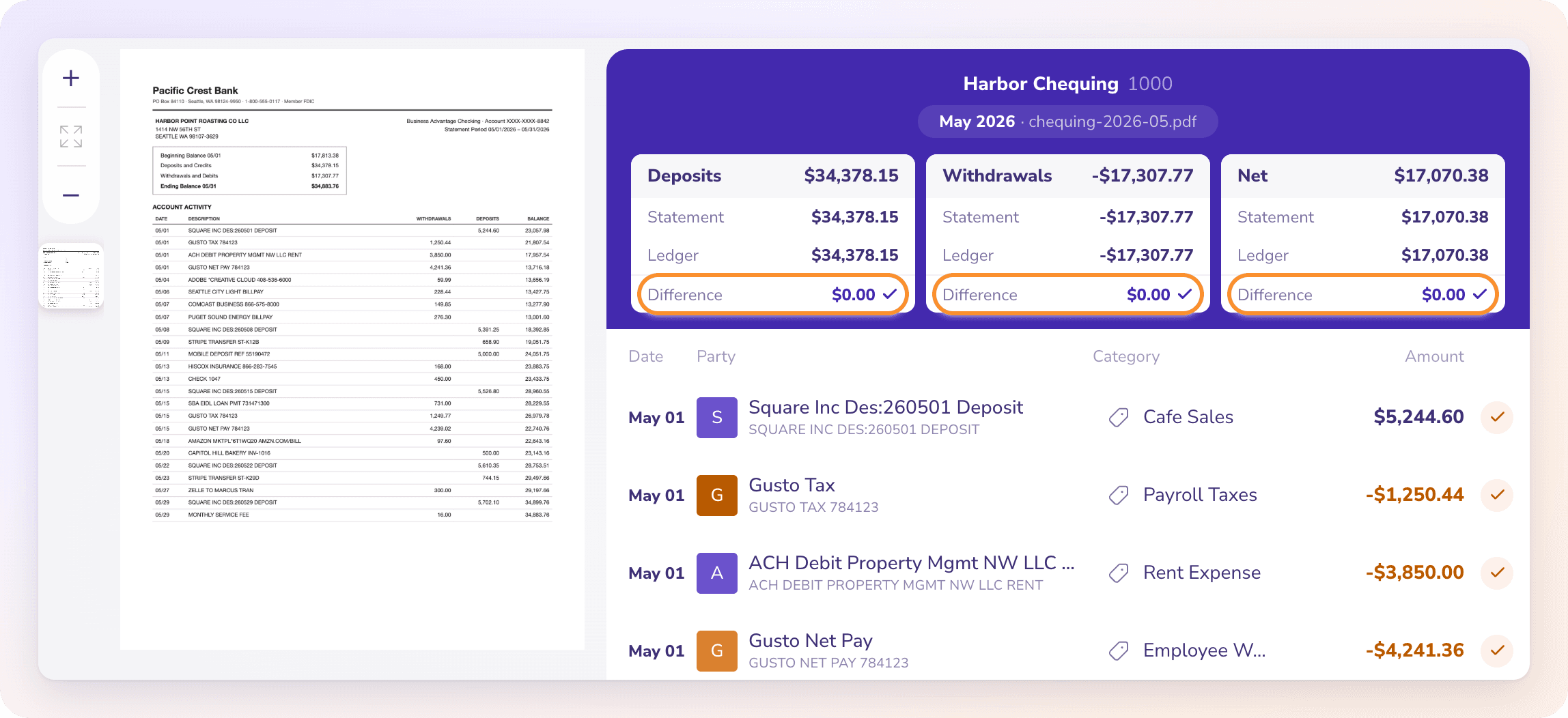
Upload the bank statement and ZeraBooks checks that it adds up, follows last month’s statement and agrees with the ledger. A month that ties gets a check; one that doesn’t shows the difference. More on bank reconciliation software.
WHEN IT DOESN’T TIE
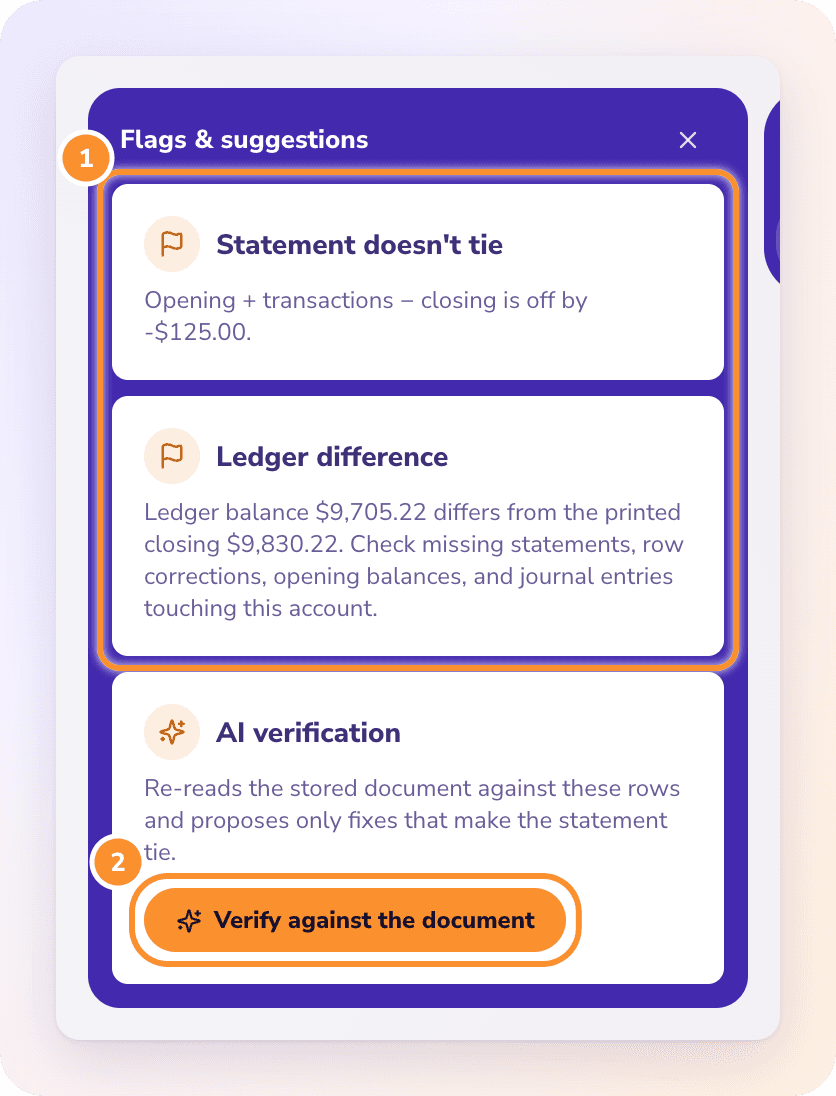
AI re-reads the statement and proposes the fix.
Verify against the document compares the original statement line by line with your rows and proposes only fixes that make the month tie, each quoting the line it’s based on. You apply them, then sign off and close the month.
Every month, for every bank and card account, when the statement arrives. Busy accounts can be reconciled weekly against the online balance, but the monthly statement reconciliation is the one that counts.
What is a deposit in transit?+
Money you recorded as deposited that the bank hadn’t processed by the statement date, usually the last day’s deposit. Add it to the bank side; it shows up on next month’s statement.
What is an outstanding check?+
A check you wrote and recorded that hadn’t cleared the bank by the statement date. Subtract it from the bank side and carry it on the list until it clears.
Do bank-side items need journal entries?+
No. Deposits in transit and outstanding checks are already in your books; the bank catches up next month. Only book-side items, such as fees, interest and errors, need entries.
Can you reconcile a credit card the same way?+
Yes. Use the card statement’s new balance, and treat charges not yet posted like outstanding checks. Payments and charges are compared instead of deposits and checks.
Is there software that reconciles automatically?+
ZeraBooks reconciles every account month by month as soon as a statement is uploaded, from $79 a month billed annually after a 7-day trial. Prefer someone else to do it? Our bookkeeping services team reconciles and closes each month for you.
Upload last month’s statement. See whether it ties.
ZeraBooks reconciles on upload and shows any difference with the line behind it. Free for 7 days, then $79 a month billed annually; see ZeraBooks pricing.