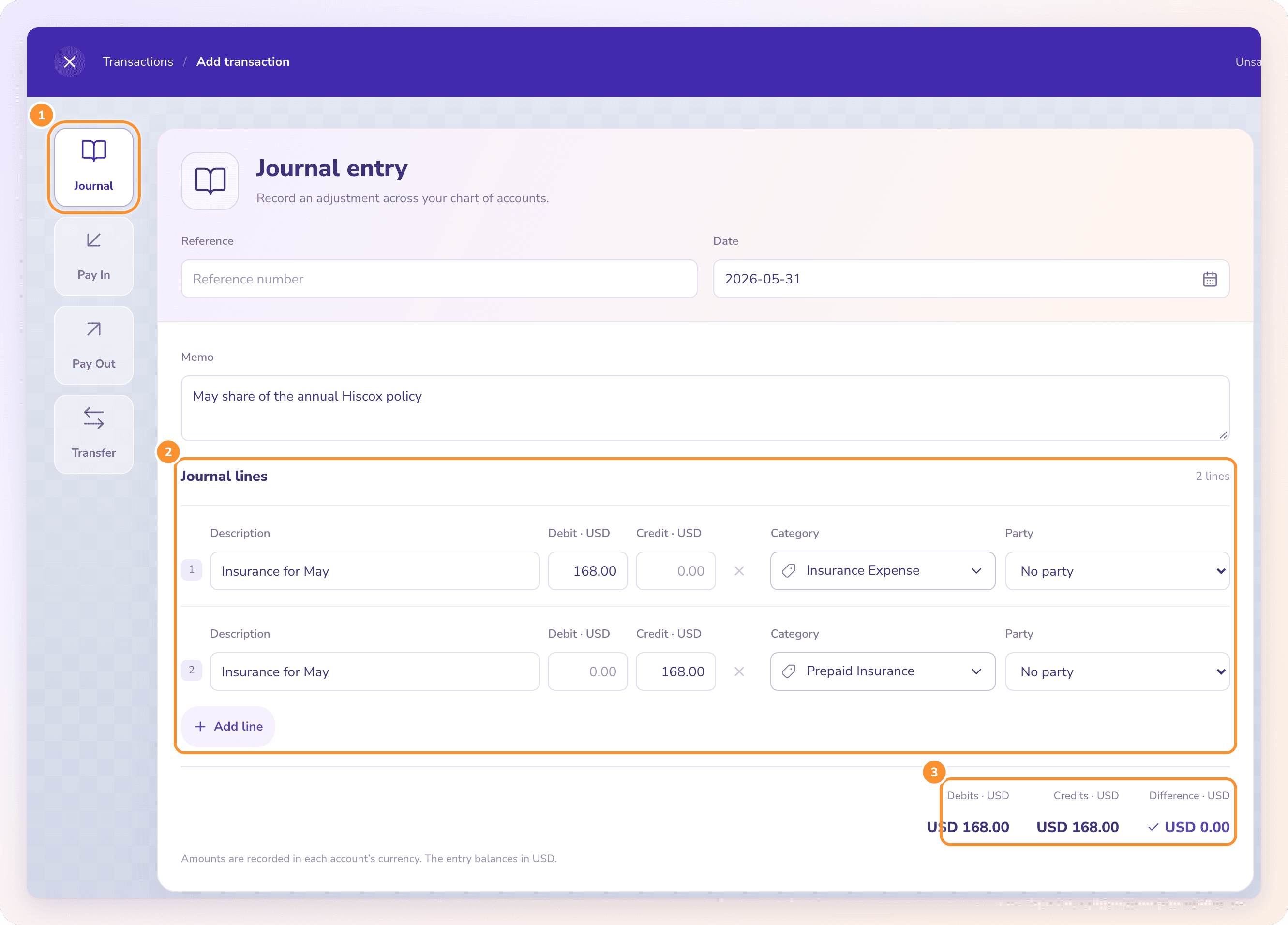
How to calculate depreciation, from the cost of the asset to the monthly entry.
To calculate straight-line depreciation, subtract the salvage value from what the asset cost and divide by its useful life in years. Divide by 12 for the monthly figure. A 20,000.00 oven expected to be worth 2,000.00 after 10 years depreciates 1,800.00 a year, or 150.00 a month. The ZeraBooks general ledger can record that entry every month.
7-day trial · card required, nothing charged for 7 days · then $79/month billed annually or $149 monthly
DEFINITION
What is a depreciation?
Spreading the cost of something a business uses for more than a year, such as an oven or a delivery van, over the years it is used. Each period’s share is an expense on the profit and loss; the total written off so far sits in accumulated depreciation on the balance sheet.
WHAT YOU NEED
What goes into a depreciation calculation?
Juniper Lane Bakery is a fictional bakery. On March 14, 2026 it bought a deck oven. These are the four figures the calculation needs:
Input
What it means
Juniper Lane’s oven
Cost
The price plus what it took to get the asset working, such as delivery and installation. Not the financing.
18,600.00 + 1,400.00 = 20,000.00
Salvage value
What you expect to sell it for at the end. Often zero for small equipment.
2,000.00
Useful life
How many years the business expects to use it.
10 years
Start date
When it was put to use. Books often start the month after, or use a half-month rule.
April 2026
The amount to spread is cost minus salvage: 20,000.00 − 2,000.00 = 18,000.00. Land is never depreciated, and small purchases are usually expensed straight away under a capitalization threshold your accountant sets, so a 300.00 mixer doesn’t need a schedule.
Try it on your own documents. One-week free trial, both apps included.
Straight-line is the same amount every full year: (20,000.00 − 2,000.00) ÷ 10 = 1,800.00 a year, and 1,800.00 ÷ 12 = 150.00 a month. Starting in April, 2026 gets nine months. Here is the oven’s full schedule:
Year
Months
Depreciation
Accumulated depreciation
Book value at year end
Bought, March 2026
0.00
20,000.00
2026
9
1,350.00
1,350.00
18,650.00
2027
12
1,800.00
3,150.00
16,850.00
2028
12
1,800.00
4,950.00
15,050.00
2029 to 2035
84
12,600.00
17,550.00
2,450.00
2036 (to March)
3
450.00
18,000.00
2,000.00
Ten years
120
18,000.00
The proof: the depreciation column adds to 18,000.00, the cost minus salvage, and the book value ends at exactly the 2,000.00 salvage value. Book value never goes below salvage. If the business keeps using the oven after 2036, it stays on the books at 2,000.00 with no more depreciation.
THE JOURNAL ENTRIES
What is the journal entry for depreciation?
Buying the oven isn’t an expense. It goes on the balance sheet as equipment, and depreciation moves a slice of it to the profit and loss each month.
Event
Debit
Credit
Amount
Oven bought, 03/14/2026
Equipment
Cash: checking
20,000.00
Each month from April 2026
Depreciation expense
Accumulated depreciation
150.00
Oven sold, 12/31/2028
Cash: checking
14,000.00
Accumulated depreciation
4,950.00
Loss on sale of equipment
1,050.00
Equipment
20,000.00
Accumulated depreciation is a contra-asset: it sits under equipment on the balance sheet and reduces it, so the original cost stays visible. On the sale, the book value was 20,000.00 − 4,950.00 = 15,050.00 and the bakery got 14,000.00, a 1,050.00 loss. Had it sold for more than book value, the difference would be a gain. If the oven was bought with a loan, the loan is a separate entry; see how to record loan payments.
OTHER METHODS
What are the other depreciation methods?
Most small businesses use straight-line in their books because it is simple and steady. Here is the oven’s first full year, 2027, under each common method:
Method
How it works
Oven, first full year
Straight-line
Cost minus salvage, divided by the years
1,800.00
Double-declining balance
Twice the straight-line rate (2 ÷ 10 = 20%) on the remaining book value; salvage is the floor
20% × 20,000.00 = 4,000.00
Units of production
Cost minus salvage per unit of use, times units used. Rated for 50,000 bake cycles; 6,000 run that year
0.36 × 6,000 = 2,160.00
Tax (MACRS, section 179, bonus)
Set by the IRS, not by how long you expect to use it
Decided by your tax preparer
Double-declining applies the 20% to the book value left each year, so year two would be 20% × 16,000.00 = 3,200.00, and so on until the book value reaches the 2,000.00 salvage. Whatever the method, the total written off over the asset’s life is the same 18,000.00; only the timing changes.
BOOKS VS TAX
Is book depreciation the same as tax depreciation?
Often not, and that is normal. The books show what the asset is worth to the business; the tax return follows IRS rules. IRS Publication 946 (2025 edition, checked October 22, 2026) sets the tax side:
MACRS
The IRS system for most business property. It assigns recovery periods by asset class rather than your own estimate, and usually treats property as placed in service halfway through the year.
Section 179
Lets a business deduct the cost of qualifying equipment in the year it is placed in service, up to 2,560,000 for tax years beginning in 2026. The limit shrinks once qualifying purchases for the year pass 4,090,000.
Bonus depreciation
A 100% first-year allowance was reinstated for certain qualified property acquired and placed in service after January 19, 2025. It applies unless the business elects out.
What it means for your books
The bakery’s tax preparer might deduct the whole 20,000.00 in 2026 on Form 4562 while the books still show 1,350.00. Keep the book schedule for your own reports and lender, and give the preparer the purchase date and cost. Your accountant decides whether the two should match.
STEP BY STEP
How to calculate and record depreciation for one asset
Do this once when you buy the asset, then post the monthly entry until it is fully depreciated or sold.
1
Add up the cost
Take the price from the invoice and add delivery, installation and setup. Leave out sales tax only if you get it back; leave out any loan.
2
Choose life and salvage
Use your accountant’s guidance or a schedule you already follow for similar assets. The same life for the same kind of asset keeps the books consistent.
3
Work out the monthly amount
Cost minus salvage, divided by the years, divided by 12. Write the start month down with it.
4
Post the entry each month
Debit depreciation expense and credit accumulated depreciation, dated the last day of the month, so each monthly profit and loss carries its share.
5
Check the balance
Accumulated depreciation should equal months elapsed times the monthly amount. Twenty-one months into the oven’s life that is 21 × 150.00 = 3,150.00, the December 2027 figure in the schedule.
6
Stop at salvage, or on a sale
When book value reaches salvage, stop. If you sell or scrap the asset, remove its cost and accumulated depreciation and record any gain or loss.
WITH ZERABOOKS
How ZeraBooks records depreciation.
ZeraBooks records book depreciation in the ledger. It doesn’t calculate tax depreciation or prepare any tax form.
AUTOPILOT, AT MONTH END
Straight-line, every month, with the math in the memo.
When your books hold equipment or other fixed assets, Autopilot records straight-line depreciation as a journal dated the last day of the month. It needs an Accumulated Depreciation and a Depreciation Expense category. The useful life comes from what has already been written off against the assets, or a standard life named in the memo. Assets bought later start the month after purchase. It never posts into a closed month or a previous fiscal year. Doing the whole close? See the month-end close checklist.
Autopilot: what the AI did, one-tap questions, undo.
YOUR CALL
It asks first when it isn’t sure.
Unsure entries come to you as a question: record this amount of depreciation for this asset? Answer yes, or tell it your accountant handles depreciation and it stops. Every entry it made is listed in Done by AI, where one click undoes it. ZeraBooks keeps no separate fixed asset register; the assets live in your chart of accounts, so a chart of accounts template with equipment and accumulated depreciation lines is the place to start.
What is the formula for straight-line depreciation?+
Annual depreciation = (cost − salvage value) ÷ useful life in years. For a month, divide the annual figure by 12. A 20,000.00 asset with 2,000.00 salvage over 10 years gives 1,800.00 a year and 150.00 a month.
How do I calculate depreciation for part of a year?+
Count the months the asset was in use and multiply by the monthly figure. An oven put to use in April has nine months in its first calendar year: 9 × 150.00 = 1,350.00. Tax rules use their own conventions, usually treating the asset as bought mid-year.
Is depreciation a cash expense?+
No. The cash left when the asset was bought. Depreciation is an expense on the profit and loss with no money moving, which is why it is added back on a cash flow statement.
Can I just expense equipment when I buy it?+
For taxes, often yes, through section 179 or bonus depreciation, and your tax preparer decides. In your books, an asset used for years is usually depreciated so each year’s profit carries its share. Very small purchases under your capitalization threshold are simply expensed.
What happens to depreciation when I sell the asset?+
Stop depreciating, remove the asset’s cost and its accumulated depreciation, record the cash, and book the difference as a gain or loss. The oven sold for 14,000.00 against a 15,050.00 book value, a 1,050.00 loss.
Can ZeraBooks do my depreciation for me?+
ZeraBooks records monthly straight-line book depreciation through Autopilot and asks when it isn’t sure. It doesn’t do MACRS, section 179 or Form 4562. Prefer a person to keep the books? Our bookkeeping services team does it from $150 a month (USD), and the software is $79 a month billed annually after a 7-day trial.
Upload a month with equipment on the books. See the depreciation entry with its math.
ZeraBooks drafts straight-line depreciation at month end and shows the calculation in the memo. Free for 7 days, then $79 a month billed annually; see ZeraBooks pricing.