GUIDE · FOR ACCOUNTANTS AND AUDITORS
Proof of cash,
a four-column example that ties.
A proof of cash is a four-column reconciliation that ties a bank account’s beginning balance, receipts, disbursements and ending balance for a period to the books, not just the ending balance. Auditors use it to find receipts and payments that never reached the books. In ZeraBooks, the accounting software for accountants, every proven statement supplies the bank side.
7-day trial · card required, nothing charged for 7 days · General Ledger and Converter from $79/month billed annually
DEFINITION
What is a proof of cash?
A proof of cash, also called a four-column bank reconciliation, reconciles the balance per bank to the balance per books at the start and end of a period, and the receipts and disbursements per bank to those per books for the period in between. Each row reads across as beginning plus receipts minus disbursements equals ending.
WORKED EXAMPLE
What does a four-column proof of cash look like?
A fictional client’s operating account for March 2026. The February reconciliation left a deposit in transit and outstanding checks; March adds a returned customer check, a bank fee and interest the books haven’t recorded yet.
| Line | Beginning, 02/28 | Receipts | Disbursements | Ending, 03/31 |
|---|---|---|---|---|
| Balance per bank | 48,210.00 | 61,385.40 | 57,902.15 | 51,693.25 |
| Deposit in transit, 02/28 | 3,150.00 | (3,150.00) | ||
| Deposit in transit, 03/31 | 4,820.00 | 4,820.00 | ||
| Outstanding checks, 02/28 | (2,640.00) | (2,640.00) | ||
| Outstanding checks, 03/31 | 5,115.60 | (5,115.60) | ||
| NSF customer check, not yet in books | (750.00) | 750.00 | ||
| Bank service fee, not yet in books | (45.00) | 45.00 | ||
| Interest credited, not yet in books | (18.37) | (18.37) | ||
| Balance per books | 48,720.00 | 63,037.03 | 59,582.75 | 52,174.28 |
Every row reads across: beginning plus receipts minus disbursements equals ending. On the bank row, 48,210.00 + 61,385.40 − 57,902.15 = 51,693.25; on the books row, 48,720.00 + 63,037.03 − 59,582.75 = 52,174.28. Once the books record the returned check, the fee and the interest, the adjusted book balance is 51,397.65, the same as the bank balance plus the March deposit in transit less the March outstanding checks.
Try it on your own documents. One-week free trial, both apps included.
READING THE ROWS
How does each reconciling item move across the four columns?
The rule for any item: it sits in the column where bank and books disagree, and in the balance column for the date it is still open.
Deposit in transit from last month
The books took it in February, the bank in March. It is added to the beginning bank balance and taken out of March bank receipts, so the two months line up.
Deposit in transit at month end
The books took it on March 31; the bank will in April. It is added to bank receipts and to the ending bank balance.
Outstanding checks from last month
Written in February, cleared in March. Taken off the beginning balance and off March bank disbursements.
Outstanding checks at month end
Written in March, not yet cleared. Added to bank disbursements and taken off the ending balance.
Returned (NSF) check
The bank took the deposit and then took it back; the books still show only the deposit. The return comes out of bank disbursements and is added back to the ending balance until it is recorded against the customer.
Bank fees and interest
On the statement, not yet in the books. A fee comes out of bank disbursements and interest out of bank receipts. Both get a journal entry, and the next month’s proof no longer shows them.
PROOF OF CASH VS BANK RECONCILIATION
How is a proof of cash different from a bank reconciliation?
A monthly bank reconciliation checks one number at one date. A proof of cash checks the flow in between, which is where an unrecorded receipt can hide.
| Compared | Bank reconciliation | Proof of cash |
|---|---|---|
| What ties | Ending balance only | Beginning balance, receipts, disbursements and ending balance |
| Catches | A difference that is still sitting in the balance | Also equal and opposite errors inside the month, such as a receipt never recorded and a payment never recorded |
| Period | One month | A month, a quarter or the whole year, usually month by month |
| Who does it | The bookkeeper, every month | Auditors and forensic accountants, and careful reviewers at year end |
An example the ending balance can’t see: a 2,000.00 customer payment was deposited and never recorded, and a 2,000.00 check to a vendor cleared and was never recorded. The ending balances agree. The receipts and disbursements columns are each 2,000.00 apart.
WHEN IT’S USED
When do auditors use a proof of cash?
Unrecorded receipts
Cash that reached the bank but not the books, for example sales kept off the records. It shows as a receipts difference that no timing item explains.
Unrecorded disbursements
Payments out of the account that never reached the books, including the second half of an offset like the example above.
Kiting
A transfer recorded as a deposit in one account before the withdrawal shows in the other, to cover a shortfall over a period end. A proof of cash on each account, read with a schedule of transfers between them, makes the overlap visible.
Cut-off
Receipts and checks recorded in the wrong month. The deposits in transit and outstanding checks at each end of the period should clear early in the next month; one that doesn’t is a question.
Divorce and dispute work
Forensic accountants use the same four columns to show what went through an account. For family law work, see bank statements for divorce.
STEP BY STEP
How do you prepare a proof of cash?
The bank side comes from the statements and the book side from the general ledger cash account. A bank statement converter saves retyping the bank side for every month.
- 1
Collect the statements
The months in the period, plus the month after, which shows whether the open items at the period end really cleared.
- 2
Prove the bank side
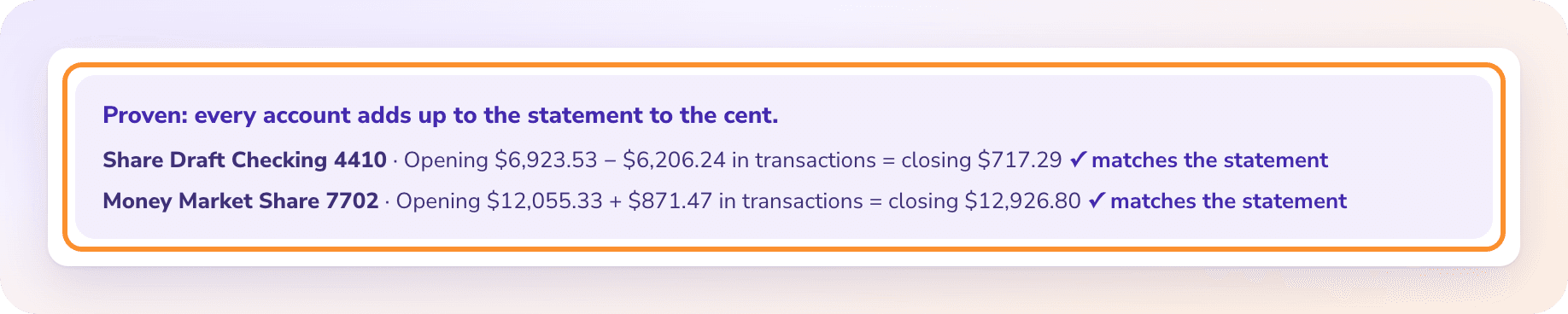
Upload the PDFs to ZeraBooks Convert. Each account must show Proven: opening balance plus its rows equals the printed closing balance, to the cent. The opening and closing balances are your beginning and ending per bank.
- 3
Total receipts and disbursements per bank
Download in Money in and out, which writes Money In and Money Out as two positive columns. Their sums for the month are receipts and disbursements per bank.
- 4
Pull the book side
From the general ledger cash account: the balance at each end of the period, total debits and total credits for the period.
- 5
List the reconciling items
Deposits in transit and outstanding checks at both ends, then anything on the statement the books lack: returned checks, fees, interest.
- 6
Tie every row and column
Each row must read across, and each column must land on the book figure. A difference left in receipts or disbursements is the finding.
TEMPLATE
Is there a proof of cash template?
The worked example above as a CSV file, with the same rows and a row check column that should read 0.00 on every line. Open it in Excel or Google Sheets and replace the amounts with your client’s.
Proof of cash template (CSV)
Four columns, eight reconciling rows and the per-bank and per-books lines from the March 2026 example. Free to use; no sign-up.
The month-end routine around it
A proof of cash sits after the monthly reconciliations in the order of work. The month-end close checklist shows where.
IN ZERABOOKS
Does ZeraBooks do a proof of cash?
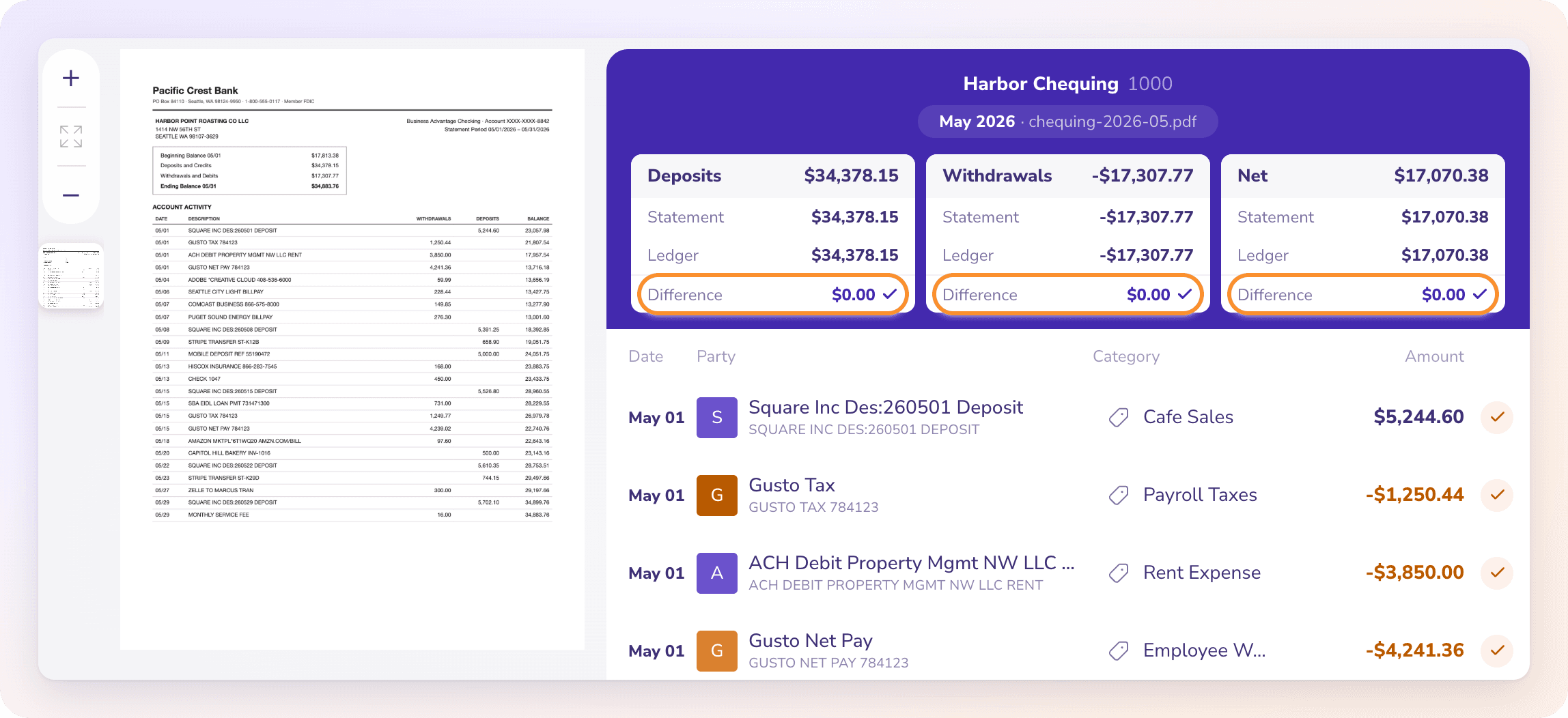
For books kept in the ZeraBooks General Ledger, every month of every account is compared with its statement in three tiles: Deposits, Withdrawals and Net, each showing the statement, the ledger and the difference. That is the receipts, disbursements and balance comparison of a proof of cash, done for each month on its own. Because the books are built from the statements, timing items rarely appear; a difference usually means a row was changed or a journal entry hit the cash account. See Fix a month that doesn’t tie.
For a client whose books are in other software, ZeraBooks Convert gives you the proven bank side and you build the four columns in a spreadsheet. ZeraBooks doesn’t keep a list of outstanding checks or deposits in transit, has no bank feed, and doesn’t perform audits.
Why is it called a four-column bank reconciliation?
Because it has four amount columns: beginning balance, receipts, disbursements and ending balance. A standard bank reconciliation has only the ending balance column.
Should a proof of cash be done for the whole year?
Auditors often do it for the year, built month by month, so a difference can be traced to the month it happened in. A one-period proof can hide offsetting differences across months.
Where do bank receipts and disbursements come from?
The statement: total deposits and credits, total withdrawals and debits. Many statements print these totals in the summary. ZeraBooks Convert checks the rows against the opening and closing balance, and its Money in and out download gives the two totals as columns; see Choose a download format.
Do transfers between the client’s own accounts count as receipts?
On the bank side, yes: the statement shows them as money in or out. They should be in the books on both accounts too, so they tie. A transfer recorded on one side only is a common finding.
How much does ZeraBooks cost?
One subscription with the General Ledger and the Converter: $79 a month billed annually or $149 monthly, after a 7-day trial, with 1,000 pages a month of conversion. See ZeraBooks pricing.
ONE-WEEK FREE TRIAL
Prove the bank side of your next proof of cash.
Free for 7 days.
Upload a client’s statements, check each one ties to its printed balances, and download the totals. Then 1,000 pages a month from $79 a month billed annually.
Last updated October 15, 2026 · Written by Damin Mutti, founder of ZeraBooks