BANK AND CARDS
Cash and cards proven on upload.
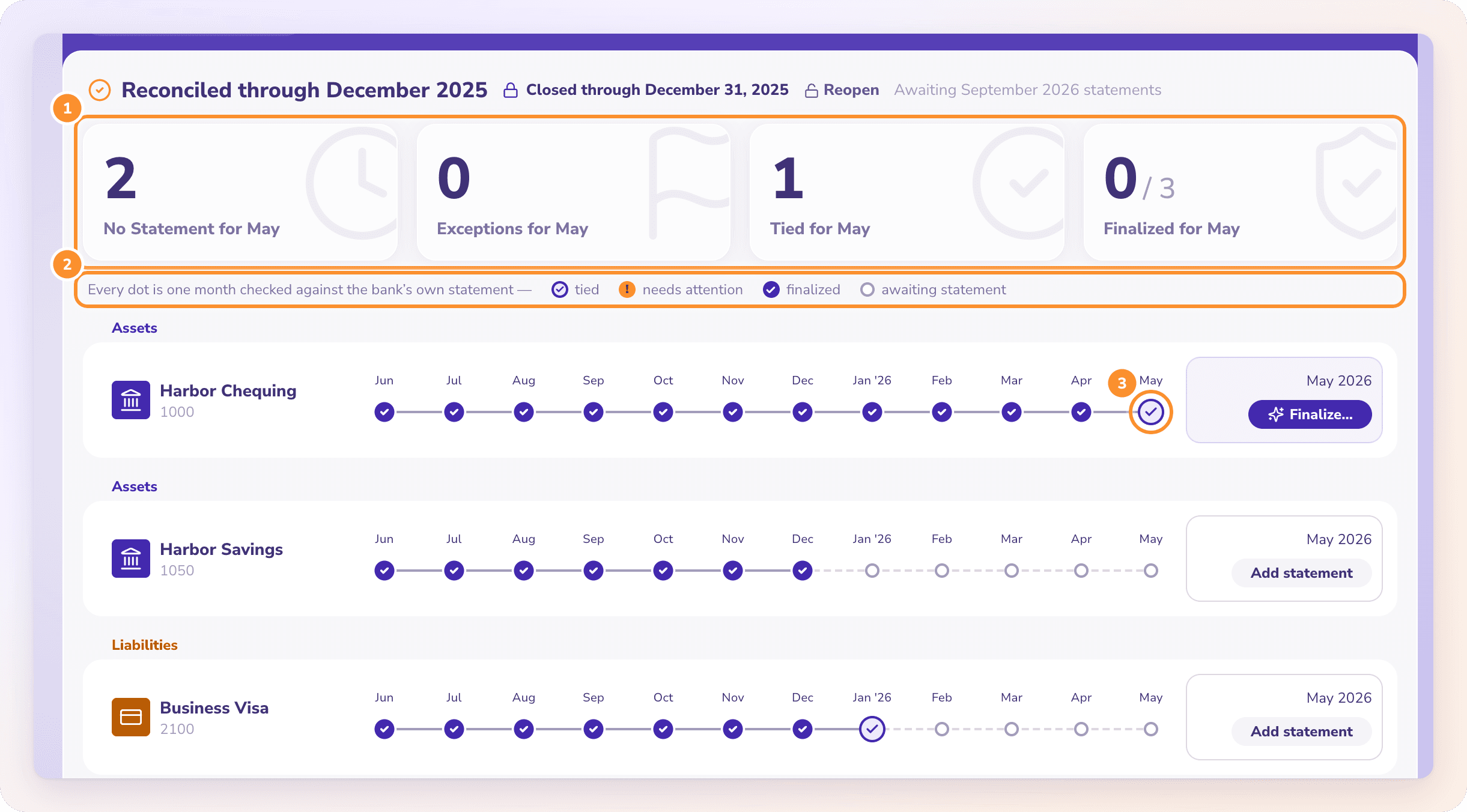
Each bank and card statement is checked against its printed balances and against the ledger, so the first two lines of the balance sheet are settled before you start. See bank reconciliation software.
GUIDE · MONTH-END
A balance sheet reconciliation matches each asset, liability and equity account’s month-end balance to a document from outside the ledger: a bank statement, an aging report, a lender statement, a schedule. Any difference is explained and corrected with a journal entry before the month closes. AI bookkeeping handles the bank and card accounts; the rest follow the same idea.
7-day trial · card required, nothing charged for 7 days · then $79/month billed annually or $149 monthly
DEFINITION
The month-end check that each balance sheet account’s ledger balance agrees with independent support, with every difference explained and corrected.
HOW TO
Work down the balance sheet from cash to equity. The profit and loss is only right if every account above it is.
Reconcile every bank and card account to its statement. Most corrections elsewhere move cash, so cash has to be settled first. The method is in how to do a bank reconciliation.
List every balance sheet account with its month-end balance. A general ledger gives you this as the trial balance.
One outside document or schedule per account, dated the same day. If an account has no support, that is the first finding.
Ledger balance minus support. Zero is done. Anything else gets a reason in plain words, not just a number.
One journal entry per difference, dated the last day of the month, booked to the account that was wrong.
Keep the support with the reconciliation and lock the month, so a later edit can’t quietly change a reconciled balance. It is one step of the month-end close checklist.
Try it on your own documents. One-week free trial, both apps included.
WHAT SUPPORTS WHAT
The support has to come from outside the account you are checking. A report built from the same ledger proves nothing.
| Account | Support | Common difference |
|---|---|---|
| Bank and savings | Bank statement and the bank reconciliation | Unrecorded fees, deposits in transit |
| Credit cards | Card statement new balance | A payment booked as an expense |
| Accounts receivable | Open invoices list (aging) by customer | A payment applied to the wrong invoice or left unapplied |
| Prepaid expenses | A schedule: amount paid, months covered, months used | The month’s expense not taken |
| Fixed assets | Asset register with cost and depreciation | A purchase expensed, or depreciation missed |
| Accounts payable | Unpaid bills list by vendor | A bill paid but not marked paid |
| Payroll liabilities | Payroll provider’s liability report | A tax deposit booked to expense |
| Sales tax payable | The period’s sales tax report or return | Tax booked into revenue |
| Loans | Lender statement, principal balance | Whole payment booked to interest |
| Equity | Last year’s closing equity, plus profit, less draws | A prior-year entry changed after the return was filed |
WORKED EXAMPLE
Copperline Studio is a fictional design studio. Its bank and card accounts already tie for August 2026. Here is the rest of the balance sheet on August 31:
| Account | Ledger | Support | Support amount | Difference |
|---|---|---|---|---|
| Checking | 24,118.62 | Bank reconciliation | 24,118.62 | 0.00 |
| Business credit card | (3,402.17) | Card statement closing August 31 | (3,402.17) | 0.00 |
| Accounts receivable | 11,850.00 | Open invoices list | 11,850.00 | 0.00 |
| Prepaid insurance | 2,800.00 | Policy schedule | 2,400.00 | 400.00 |
| Equipment, net | 18,600.00 | Asset register | 18,600.00 | 0.00 |
| Accounts payable | (2,135.40) | Unpaid bills list | (2,135.40) | 0.00 |
| Payroll liabilities | (1,960.00) | Payroll provider report | (1,720.00) | (240.00) |
| Equipment loan | (31,420.55) | Lender statement | (31,420.55) | 0.00 |
Prepaid insurance: the 4,800.00 annual policy started March 1, so 400.00 is used each month and six months are gone by August 31, leaving 2,400.00. The ledger still had 2,800.00 because August’s 400.00 was never expensed. Payroll liabilities: the provider says 1,720.00 is owed, the ledger says 1,960.00. The August 15 tax deposit of 240.00 was booked to payroll tax expense, so the liability never came down.
THE FIXES
Each difference becomes one entry that moves the balance to the support and puts the other side where it belongs.
| Entry | Debit | Credit | Amount |
|---|---|---|---|
| August insurance used | Insurance expense | Prepaid insurance | 400.00 |
| Tax deposit misbooked | Payroll liabilities | Payroll tax expense | 240.00 |
After both entries every account ties. August’s expenses go up by 400.00 − 240.00 = 160.00, so the profit and loss sent last week was 160.00 too high. That is why the balance sheet is reconciled before reports go out, not after.
WARNING SIGNS
You can spot most problems before opening a single support document.
Cash, receivables or prepaid below zero usually means a payment was booked twice or to the wrong account.
It should be empty at month end. Whatever is in it is unreconciled by definition.
A prepaid or loan account that never moves means the monthly entry is not being made.
A 500.00 adjustment with no explanation is a plug, and it hides whatever it replaced.
If last year’s closing balances moved, someone edited a closed period. Lock months after they reconcile.
WITH ZERABOOKS
The accounts with outside statements are proven automatically. The rest are visible and correctable in the same ledger.
BANK AND CARDS
Each bank and card statement is checked against its printed balances and against the ledger, so the first two lines of the balance sheet are settled before you start. See bank reconciliation software.
MONTH-END ENTRIES
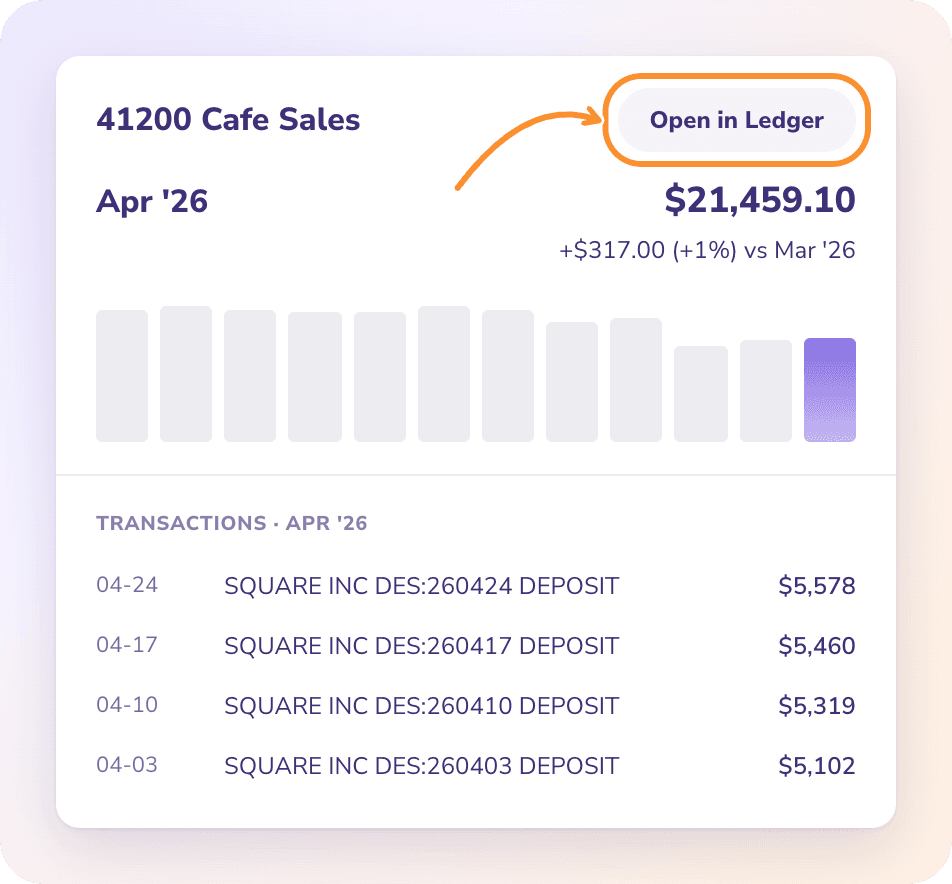
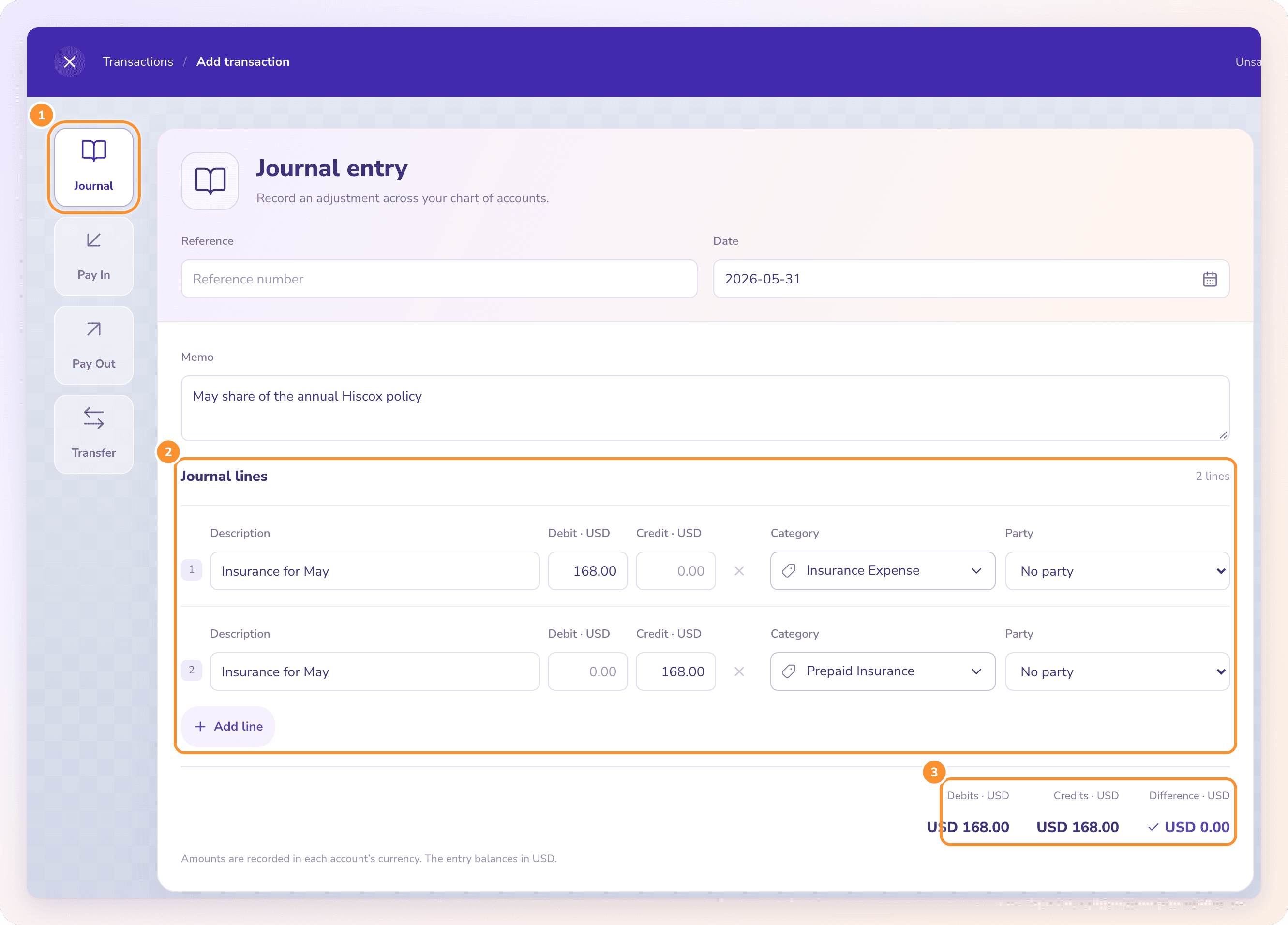
These are posted at month end, so the accounts that most often drift are kept current. Anything else is a journal entry with debits and credits that must balance before saving.
SIGN OFF
A reconciled month is closed so nothing in it changes by accident. If a correction is needed later, the month is reopened and the history is kept.
A bank reconciliation checks one account, cash, against the bank statement. A balance sheet reconciliation checks every account on the balance sheet, and the bank reconciliation is its first step.
Every month, before the month’s reports go out. Cash and cards need it monthly at the least. Small accounts that rarely move can be checked quarterly, but they still need support at year-end.
Yes, by roll-forward rather than a document: last year’s closing equity plus this year’s profit, plus contributions, less draws or dividends, should equal the balance. If it doesn’t, a closed period was changed.
Whoever keeps the books prepares it, and ideally someone else reviews it. If you would rather hand it over, ZeraBooks bookkeeping services reconcile and close each month for you.
For bank and card accounts, yes: ZeraBooks proves them against the statements as they are uploaded, from $79 a month billed annually after a 7-day trial. Receivables, payables and payroll still need their outside reports compared, and the worked example above shows how.
ONE-WEEK FREE TRIAL
ZeraBooks proves your bank and card accounts on upload and keeps the month-end entries current. $79 a month billed annually after a 7-day trial; see ZeraBooks pricing.
Last updated October 19, 2026 · Written by Damin Mutti, founder of ZeraBooks