Reconcile a bank statement with the ledger, starting from the cash account, ending with the entries.
To reconcile a bank statement with the general ledger, take the cash account’s balance on the statement date, adjust the bank’s closing balance for deposits in transit and outstanding checks, and post a journal entry for each difference that is the ledger’s fault: fees, returned checks, interest, duplicates and wrong-account postings. ZeraBooks AI bookkeeping checks this on upload.
7-day trial · card required, nothing charged for 7 days · then $79/month billed annually or $149 monthly
DEFINITION
What is a cash account (general ledger)?
The balance sheet account in the general ledger that stands for one bank account, such as 1010 Cash: Operating. Every deposit and payment posted to it should also appear on that bank’s statement, sooner or later.
THE LEDGER SIDE
Which ledger balance do you reconcile to the bank statement?
Most failed reconciliations go wrong before any matching starts, because the ledger figure was pulled the wrong way. Get these right first.
1
One cash account per bank account
Reconcile 1010 Cash: Operating to the operating statement only. If two bank accounts share one ledger account, split it first; nothing can tie while they are mixed.
2
The balance on the statement’s last day
Run the account’s detail report through the statement end date, not today. Entries dated after June 30 belong to July’s reconciliation.
3
Every entry posted, none in draft
Unposted bills, payments or journals are invisible to the ledger balance. Post or delete them before you pull the figure.
4
Start from last month’s reconciled balance
The cash account’s opening balance for June must equal May’s reconciled ledger balance. If someone changed a May entry after May was reconciled, find that first; it isn’t a June problem.
5
Bring last month’s open items
Deposits in transit and outstanding checks at May 31 should clear on June’s statement. Any that don’t are still open and go on June’s list.
Try it on your own documents. One-week free trial, both apps included.
How do you get the cash account balance for the reconciliation?
Tamarack Print Shop is a fictional business. Its June 2026 statement for operating checking closes at 24,618.35. Here is the ledger’s 1010 Cash: Operating account rolled forward for June:
1010 Cash: Operating
Amount
Balance 06/01/2026 (May’s reconciled balance)
21,904.30
Receipts posted in June
41,862.40
Disbursements posted in June
-35,216.55
Ledger balance 06/30/2026
28,550.15
The ledger shows 28,550.15 and the bank shows 24,618.35, a 3,931.80 gap. Some of that is timing and some is the ledger being wrong. The next step sorts them. Check 2198 for 860.00 was outstanding at May 31 and cleared on June 4, so it is off the list and needs nothing.
WORKED EXAMPLE · STEP 2
How do you reconcile the bank statement to the general ledger?
Tick off everything that appears on both the statement and the account detail. What is left goes into two columns: timing differences on the bank side, ledger errors on the book side.
Bank side
Amount
Ledger side
Amount
Statement closing balance
24,618.35
1010 balance 06/30
28,550.15
Add: deposit in transit 06/30
3,420.00
Less: service charge
-28.00
Less: check 2214
-1,186.40
Less: returned check, Halvorsen Dental
-615.00
Less: check 2216
-742.15
Less: returned item fee
-12.00
Add: interest earned
4.65
Less: Birch Street Cafe payment posted twice
-1,250.00
Less: utility bill paid from operating, posted to 1020 Savings
-540.00
Adjusted bank balance
26,109.80
Adjusted ledger balance
26,109.80
The proof: 24,618.35 + 3,420.00 − 1,186.40 − 742.15 = 26,109.80, and 28,550.15 − 28.00 − 615.00 − 12.00 + 4.65 − 1,250.00 − 540.00 = 26,109.80. Difference 0.00. The bank side needs no entries; those items will clear in July. Every line on the ledger side needs one.
WORKED EXAMPLE · STEP 3
What journal entries fix the ledger after a bank reconciliation?
Date each entry June 30 (or the date on the statement) so June’s cash account lands on 26,109.80.
Item
Debit
Credit
Amount
Service charge
Bank fees
1010 Cash: Operating
28.00
Returned customer check
Accounts receivable: Halvorsen Dental
1010 Cash: Operating
615.00
Returned item fee
Bank fees
1010 Cash: Operating
12.00
Interest
1010 Cash: Operating
Interest income
4.65
Duplicate customer payment
Accounts receivable: Birch Street Cafe
1010 Cash: Operating
1,250.00
Wrong cash account
1020 Cash: Savings
1010 Cash: Operating
540.00
Net effect on 1010: −28.00 − 615.00 − 12.00 + 4.65 − 1,250.00 − 540.00 = −2,440.35, taking 28,550.15 to 26,109.80. The returned check goes back to the customer’s receivable, so Halvorsen Dental owes the 615.00 again. Reversing the duplicate reopens 1,250.00 on Birch Street Cafe’s invoice, which is right: it was only paid once. The 540.00 fix also corrects 1020, which had been charged for a bill it never paid; that account’s own reconciliation would have been 540.00 short.
LEDGER ERRORS
What ledger mistakes show up in a bank reconciliation?
Timing items explain themselves next month. These don’t, and each one has a tell.
Posted to the wrong cash account
One account is short by the amount and another is over by the same amount. Reconcile every bank account in the same sitting and the pair jumps out.
Recorded twice
A payment entered by hand and then again from a bank import. The statement shows it once; the ledger detail shows two lines with the same amount and payee.
A returned check never reversed
The deposit is in the ledger and the bank later took it back. Reverse it to the customer, not to an expense, or the receivable disappears.
Fees and interest only the bank knew about
Small amounts dated on the last day of the statement. Common, harmless, and easy to forget for months.
An entry dated in the wrong month
A June check dated July in the ledger looks like a missing payment in June and a mystery in July. Fix the date instead of adding an entry.
A plug
Never post the leftover difference to suspense or miscellaneous to make it tie. A plug hides the real error and makes next month harder. See how to undo a bank reconciliation if a past month was forced.
AFTER IT TIES
What do you do once the ledger and the statement agree?
1
Rerun the cash account
Pull 1010 again through June 30. It should read 26,109.80, the adjusted bank balance, and match the reconciliation report you keep.
2
Keep the open items list
The deposit in transit and checks 2214 and 2216 carry into July. Each should clear on July’s statement; one still open after 90 days is worth a phone call.
3
Save the evidence
File the statement, the reconciliation and the journal entries together for the month. Your accountant or a lender may ask for them.
4
Close the month
Lock June in your software so a late edit can’t change a reconciled balance. Then finish the rest of the month-end close.
WITH ZERABOOKS
How ZeraBooks checks the ledger against the statement.
In ZeraBooks each bank account is a ledger account, and every uploaded statement is checked against it.
THREE CHECKS ON UPLOAD
The statement adds up, follows last month, and agrees with the ledger.
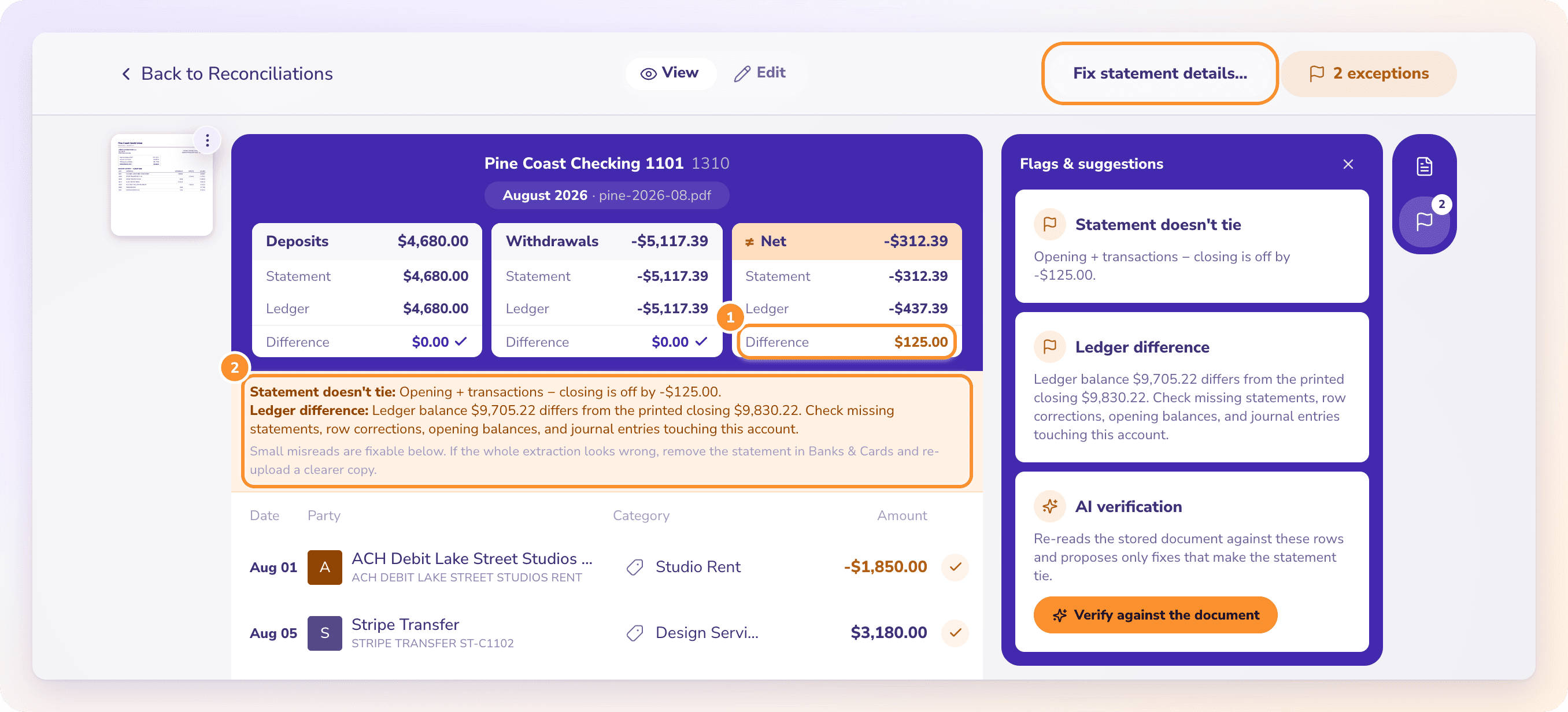
Upload the statement and ZeraBooks checks that its opening balance plus every line equals the printed closing balance, that it opens where last month’s closed, and that the account’s ledger balance equals the closing balance. A month that doesn’t agree shows the difference for deposits, withdrawals and net. More on bank reconciliation software.
A payment you recorded by hand that the statement also shows is offered for matching, so it is counted once. You pick the manual entry it matches, or Keep as separate activity if they really are two payments. Ledger fixes like the ones above go in as journal entries, with debits and credits that must balance before saving.
Is reconciling to the general ledger different from a bank reconciliation?+
It is the same reconciliation seen from the books. The bank side lists timing items; the ledger side lists errors and missing entries in the cash account, and those become journal entries. The general method, with a transposed amount, is in how to do a bank reconciliation. A common ledger-side error is a line entered twice; see how to handle duplicate transactions.
Do outstanding checks need a journal entry?+
No. They are already in the ledger. They clear on a later statement, so they only appear on the bank side of the reconciliation. Bank charges such as returned-check fees do; see how to handle NSF fees.
What if the ledger opening balance doesn’t match last month’s reconciled balance?+
Something dated in an earlier month changed after that month was reconciled. Find it in the account’s audit trail or detail report before you reconcile the current month.
Should I reconcile the savings account at the same time?+
Yes, if money moves between them. A posting to the wrong cash account leaves one account short and the other over by the same amount, and you only see the pair when both are done.
What is a proof of cash?+
A four-column version that reconciles opening balance, receipts, disbursements and closing balance separately, so offsetting errors can’t hide. See proof of cash.
Can software reconcile the ledger for me?+
ZeraBooks checks every statement against the ledger as soon as it is uploaded, from $79 a month billed annually after a 7-day trial.
Upload a statement. See whether the ledger agrees.
ZeraBooks compares every month with the bank’s own balances and shows the difference when there is one. 7-day trial, then $79 a month billed annually; see ZeraBooks pricing.