GUIDE · LAW FIRM BOOKKEEPING
Bookkeeping for law firms:
the trust account comes first.
Bookkeeping for law firms and lawyers is ordinary bookkeeping plus one strict rule: client money in the trust or IOLTA account is never the firm’s until it is earned. The trust balance must equal what the firm owes clients and the sum of every client ledger, checked monthly. ZeraBooks bookkeeping services keep the firm’s books and the trust liability.
Free call · a quote for your scope · your own read-only login and upload portal
TRUST ACCOUNTING
What trust account rules do a law firm’s books have to follow?
Each state bar writes its own rules, most of them based on ABA Model Rule 1.15. Check your state’s version; these are the points bookkeeping most often gets wrong.
Never commingle
Firm money stays out of the trust account. The usual exception is a small amount of the lawyer’s own money to cover bank charges, and only if your state allows it. Firm bills are never paid from trust, even for a day.
Earned fees leave promptly
Leaving earned fees in trust is commingling too. Once a fee is billed and earned, transfer it to operating, then record the revenue there.
Retainers are unearned until the work is done
An advance fee deposit belongs to the client and goes into trust. It moves to operating only as invoices are earned. A true retainer paid just to secure the lawyer’s availability can be earned on receipt in some states, but the engagement letter has to say so.
No client ledger goes below zero
Paying one client’s costs before that client’s money has cleared spends another client’s money. Wait for deposits to clear, especially settlement checks, before disbursing against them.
Card fees don’t come out of trust
If clients pay retainers by card, set the processor to take its fees from the operating account. Fees deducted from trust take client money for a firm expense.
IOLTA interest is not firm income
An IOLTA account pools small or short-term client deposits, and the bank pays the interest to the state’s IOLTA program, which funds legal aid. A large or long-held sum for one client goes in its own interest-bearing trust account, with the interest belonging to that client.
Keep the records for years
Model Rule 1.15 asks for complete trust records kept five years after the representation ends. Monthly statements, client ledgers and each reconciliation are the records an audit will ask for first.
Tell us about your books. We’ll scope the work and quote it before anything starts.
CHART OF ACCOUNTS
What chart of accounts does a law firm need?
A small firm’s chart has the usual business categories plus a matched pair: the trust bank account and the liability for the client money it holds. Those two balances must always agree.
| Type | Category | What goes in it |
|---|---|---|
| Asset | Operating checking 1187 | Earned fees, firm expenses, payroll funding |
| Asset | IOLTA trust account 5521 | Client retainers and settlement funds. Its balance is never the firm’s money |
| Asset | Client costs advanced | Filing fees, expert fees and records charges the firm paid for a client and will bill back |
| Liability | Client trust funds | Every dollar in the trust account, owed to clients. Deposits add to it, disbursements and earned fees reduce it |
| Liability | Business credit card | Firm spending on the card, paid from operating |
| Revenue | Legal fees › Hourly, › Flat fee, › Contingency | Fees once earned and moved out of trust, or paid straight to operating |
| Expense | Malpractice insurance | Annual or monthly professional liability premiums |
| Expense | Bar dues and CLE | License fees, bar memberships, continuing legal education |
| Expense | Legal research and practice software | Research subscriptions, practice management and e-filing services |
| Expense | Merchant fees | Card processing fees, charged to operating, never to trust |
| Equity | Partner capital and partner draws | One pair per partner |
Client costs advanced is an asset, not an expense. When the client repays, the asset clears, so a $400 filing fee never shows as both a cost and income.
WORKED EXAMPLE
Example: one month of a law firm’s trust account
A fictional four-lawyer firm’s IOLTA account for May, starting at $17,000.00 held for two clients. Every line is on the trust statement and goes to Client trust funds, except the two transfers to operating.
| Date | Trust statement line | Amount | Client | Where it goes in ZeraBooks |
|---|---|---|---|---|
| May 1 | Opening balance | 17,000.00 | Ruiz estate 12,000.00, Harbor Dental lease 5,000.00 | Client trust funds |
| May 4 | Deposit, retainer check | 7,500.00 | Okafor | Client trust funds |
| May 9 | Deposit, insurer settlement | 60,000.00 | Patel | Client trust funds |
| May 16 | Check 1042, client’s share | (38,400.00) | Patel | Client trust funds |
| May 16 | Check 1043, medical lien payoff | (1,600.00) | Patel | Client trust funds |
| May 16 | Transfer to CHK 1187 | (20,000.00) | Patel, one-third contingency fee | Transfer to Operating 1187, then the month-end journal entry |
| May 29 | Transfer to CHK 1187 | (3,850.00) | Ruiz estate, April invoice earned | Transfer to Operating 1187, then the month-end journal entry |
| May 31 | Closing balance | 20,650.00 | Ruiz 8,150.00, Harbor 5,000.00, Okafor 7,500.00, Patel 0.00 | Client trust funds 20,650.00 |
The month-end journal entry for the earned fees: debit Client trust funds $23,850.00, credit Legal fees › Contingency $20,000.00 and Legal fees › Hourly $3,850.00. The Patel settlement was held a week before disbursing so the insurer’s check cleared first.
THREE-WAY RECONCILIATION
What is a three-way trust reconciliation?
A three-way reconciliation shows that three numbers agree on the same date. For the firm in the example, all three are $20,650.00 on May 31.
The bank’s number
The trust statement’s closing balance, adjusted for checks written but not yet cashed and deposits not yet credited. In the example nothing was outstanding, so it is the printed $20,650.00.
The books’ number
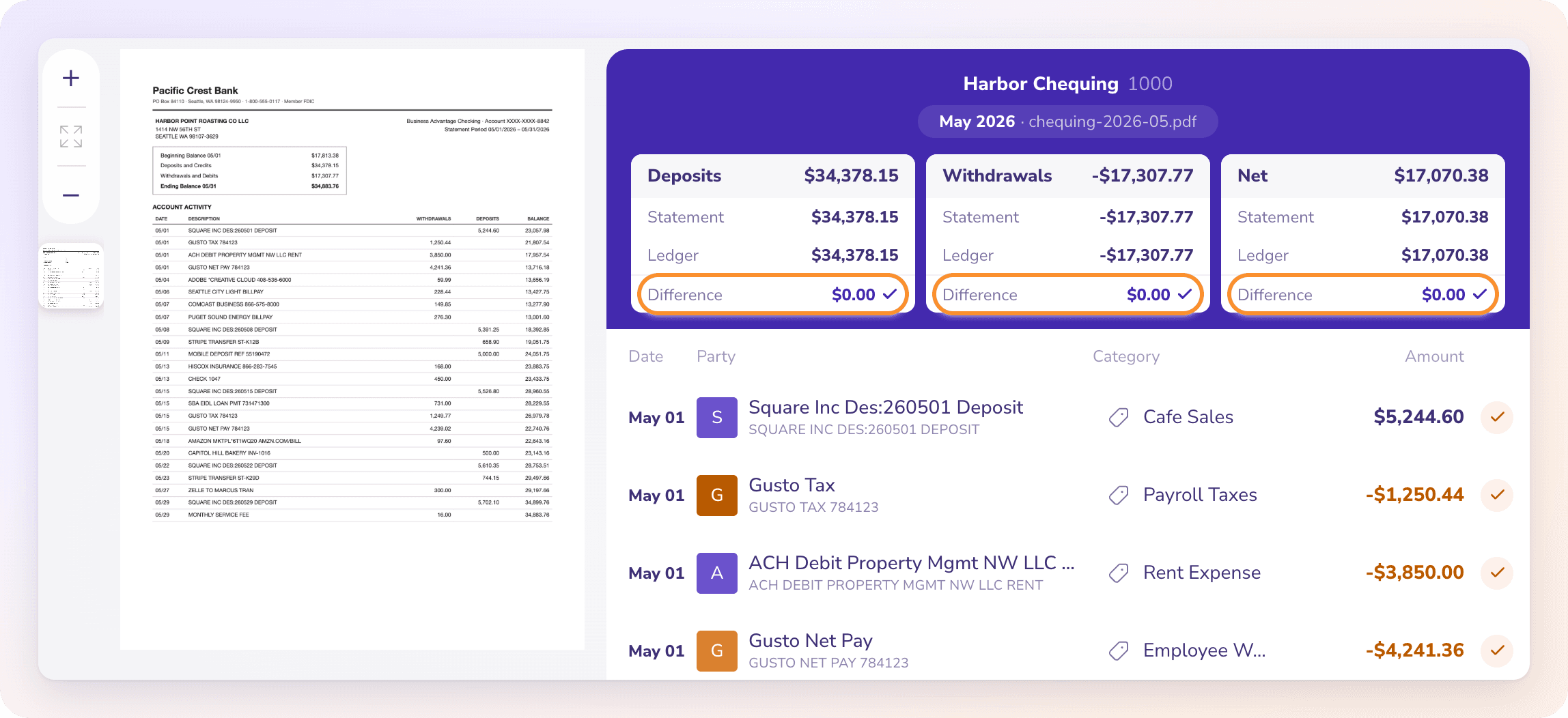
The trust account balance in the general ledger, which equals the Client trust funds liability. ZeraBooks proves this one against the statement every month.
The clients’ number
The total of every client’s trust ledger: $8,150.00 + $5,000.00 + $7,500.00 + $0.00. Client ledgers come from your trust accounting or practice management software; ZeraBooks does not keep them.
When they don’t agree
A difference usually means a deposit posted to the wrong client, a fee transferred before it was billed, or a bank charge taken from trust. Fix it before the next month, and keep the signed reconciliation with the statement. Many states require this monthly.
IN ZERABOOKS
How does ZeraBooks keep a law firm’s books?
The firm can hand this routine to our bookkeepers or run it in ZeraBooks itself. Don’t confuse this with the three checks ZeraBooks runs on every bank statement; those prove the bank and books agree, and the client ledgers are the third leg you bring.
- 1
Add both accounts by name and number
For example “Operating 1187” and “IOLTA 5521”. A trust statement line that says “TRANSFER TO CHK 1187” then finds the operating account. More on how ZeraBooks pairs transfers between your accounts.
- 2
Tell Zera the trust rule
For example, “every deposit and check on IOLTA 5521 goes to Client trust funds”. Ask Zera keeps the rule, so retainers never land in revenue.
- 3
Upload both statements each month
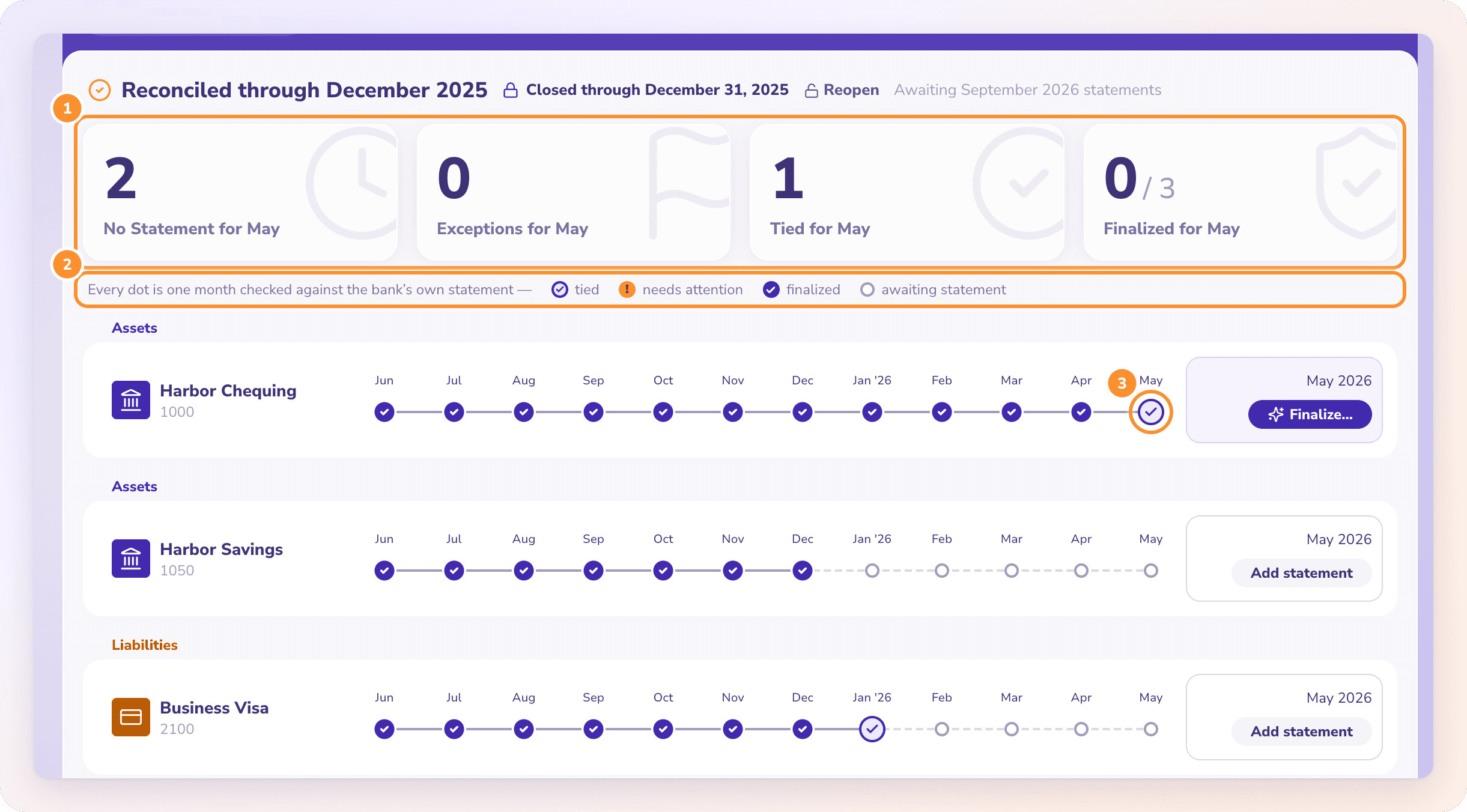
PDF or CSV. ZeraBooks checks each statement adds up, follows the last one, and agrees with the ledger. Our page on bank reconciliation software shows those checks.
- 4
Post the earned-fee entry
A transfer from trust to operating is paired as a transfer between your own accounts, which is right for the cash. It leaves the fee inside the trust liability, so one journal entry a month moves the earned total from Client trust funds to Legal fees, as in the example.
- 5
Compare with the client ledgers and close
Check that Client trust funds equals the trust account balance and your client ledger total, then close the month so nothing in it changes by accident. See how reconciliation works.
Is bookkeeping for lawyers different from bookkeeping for a law firm?
Not in the rules. A solo lawyer holding client money needs the same trust account, the same liability and the same monthly three-way reconciliation as a large firm. The difference is volume.
Can ZeraBooks keep client trust ledgers?
No. ZeraBooks keeps the trust bank account and the total owed to clients, proven against the statement. Each client’s ledger stays in your trust accounting or practice management software.
Does ZeraBooks do time tracking or legal billing?
No. Bill from your practice management software. ZeraBooks records the fees when they are earned and paid, and the costs you advance for clients.
Does ZeraBooks connect to our bank or our card processor?
No. Statements for the operating and trust accounts are uploaded as PDF or CSV. There is no bank feed and no card processing.
We need a client’s bank statements in a spreadsheet for a case. Can ZeraBooks do that?
Yes. The bank statement converter turns a client’s or opposing party’s PDF statements into Excel or CSV, proven against the printed balances, separately from the firm’s own books.
How much does law firm bookkeeping cost with ZeraBooks?
If our team keeps the books, the price is a monthly quote agreed on a free call, and it depends mostly on how many accounts and trust clients you have. A firm that keeps its own books uses the software at $79 a month billed annually or $149 monthly, with a 7-day trial first. Details are on ZeraBooks pricing.
Do nonprofits have a similar problem with money held for others?
A milder one. Restricted grants can only be spent on their purpose, and conditional grants are held as a liability until earned. Our guide to bookkeeping for nonprofits works through a month.
WE DO YOUR BOOKS
Send us last month’s operating and trust statements.
We’ll quote the books before any work starts.
Tell us how many accounts the firm holds and how many clients have money in trust. The firm gets a read-only login and can open any entry our team posts.
Last updated October 14, 2026 · Written by Damin Mutti, founder of ZeraBooks