GUIDE · ANALYSIS
Bank statement analysis,
from a spreadsheet you can trust.
Bank statement analysis summarizes months of statements into the figures a lender, court or auditor asks for: real business deposits after transfers between your own accounts, NSF and overdraft counts, recurring and large deposits, and month-end balances. It starts with every statement in one spreadsheet, which ZeraBooks Convert produces and checks against each printed balance.
7-day trial · card required, nothing charged for 7 days · 1,000 pages a month from $79/month billed annually
WHO ASKS AND WHY
What does each kind of bank statement analysis look for?
The spreadsheet is the same. The questions change with who is reading it.
| Reader | Main question | Figures they pull |
|---|---|---|
| Lender or underwriter | Can this business or borrower carry the payment? | Average monthly deposits net of transfers, NSF and overdraft count, lowest balance, existing loan payments |
| Family law team | What came in, what went out, and where did it go? | Deposits by source, transfers to other accounts, large withdrawals, spending by payee |
| Auditor or accountant | Do the books agree with the bank? | Total receipts and payments per month against the ledger, unrecorded items, cut-off at period end |
| Owner | Where is the cash going? | Recurring charges, fees, deposits by customer, month-end balances |
How many months a lender or court wants depends on the loan or the case. Ask for the list in writing before you download anything. For divorce work, our guide to bank statements for divorce covers the disclosure layout.
Try it on your own documents. One-week free trial, both apps included.
WORKED EXAMPLE
What does a three-month bank statement analysis look like?
A fictional landscaping company applies for an equipment loan with July to September 2026 checking statements. After converting them into one sheet, the summary is:
| Month | All deposits | Own-account transfers in | Business deposits | Withdrawals | Closing balance | NSF or overdraft items |
|---|---|---|---|---|---|---|
| July | 48,300.00 | 5,000.00 | 43,300.00 | 46,950.00 | 9,880.00 | 0 |
| August | 41,750.00 | 0.00 | 41,750.00 | 47,210.00 | 4,420.00 | 2 |
| September | 52,600.00 | 8,000.00 | 44,600.00 | 50,135.40 | 6,884.60 | 1 |
| Three months | 142,650.00 | 13,000.00 | 129,650.00 | 144,295.40 | Average deposits 43,216.67 | 3 |
Each closing balance follows from the one before: 8,530.00 + 48,300.00 − 46,950.00 = 9,880.00, then 4,420.00 and 6,884.60, matching the printed statements. Counting the 13,000.00 moved from savings as income would overstate deposits by about 10%. The three NSF items in August and September are the first thing an underwriter will ask about.
THE CHECKS
Which figures matter most in a bank statement analysis?
Deposits net of transfers
Take out money moved between your own accounts and loan advances. Convert the other account’s statements too, so each transfer can be matched to its other side. The month-to-month balance chain in combine bank statements catches a missing month.
NSF and overdraft items
Filter the Fee rows and the descriptions for words like NSF, returned item or overdraft. Count them by month; the dollar amount matters less than how often it happens.
Recurring deposits
Sort deposits by description to see which customers or payers come back every month. Steady repeat income reads very differently from one large job.
Large or unusual deposits
Anything well above the normal deposit size gets a source and a document. Lenders and opposing counsel both ask.
Lowest and closing balances
Month-end balances come from the statement. If you need the lowest daily balance, read it from the statement’s daily balance section; Convert lists transactions, not daily balances.
STEP BY STEP
How do you analyze bank statements in Excel?
- 1
Download every statement as PDF
From each bank, for every account and every month asked for. The PDF has the opening and closing balances that prove nothing is missing.
- 2
Convert and check them
Upload them to ZeraBooks Convert. Each account is checked against its printed balances; a statement marked Needs a look gets fixed before anyone relies on it.
- 3
Download them together
Tick all the statements and download one Excel file with an Account column, or a tab per account.
- 4
Tag the transfers
Mark deposits and withdrawals that are moves between the same owner’s accounts, so they drop out of the totals.
- 5
Build the summary
A pivot table by month and Type gives deposits, withdrawals and fees. Add the NSF count and the closing balance from each statement, as in the example.
Does ZeraBooks do the analysis for me?
No. ZeraBooks Convert turns statements into a checked spreadsheet; the analysis is done in Excel, by you or your analyst. It does not score applicants or flag NSF items automatically.
Why does the balance check matter for analysis?
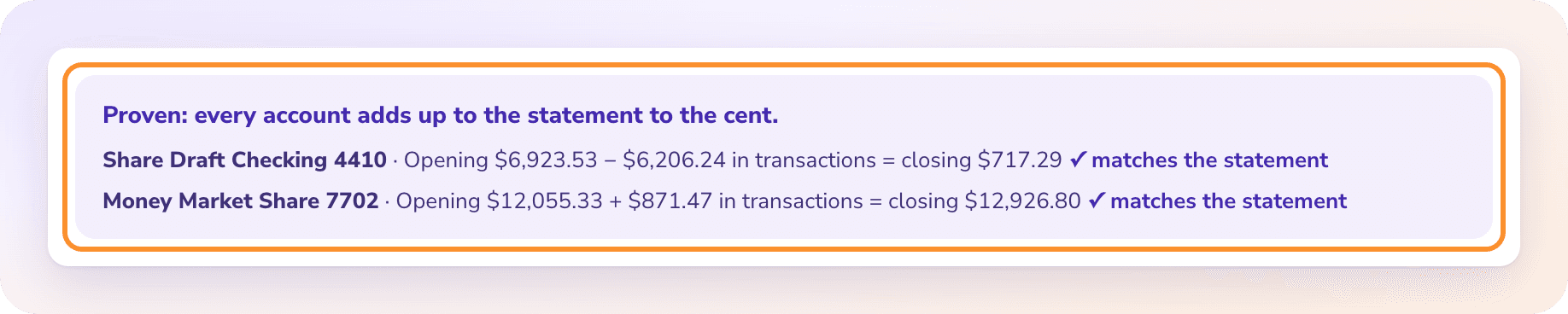
An analysis is only as good as its rows. When every statement adds up from its printed opening balance to its printed closing balance, nobody can say a page or a transaction was left out. Auditors run a wider version of this test, the proof of cash.
Can it handle scanned statements from a borrower?
Yes, if the scan is readable. Each one still has to tie to its printed balances, which is how a misread digit shows up.
How much does it cost?
Convert comes with the ZeraBooks subscription: 1,000 pages a month for $79 a month billed annually or $149 monthly, after a 7-day trial. Larger plans cover 2,500 and 5,000 pages. See the bank statement converter.
Does ZeraBooks connect to the applicant’s bank?
No. There is no bank connection. The statements are downloaded as PDFs and uploaded.
ONE-WEEK FREE TRIAL
Start the analysis from checked rows.
Try it for 7 days.
Every statement converted and proven to its printed balances, then one file for Excel. Keeping the books as well? AI bookkeeping in the ZeraBooks General Ledger reconciles every month for you.
Last updated October 20, 2026 · Written by Damin Mutti, founder of ZeraBooks