INDUSTRY · MEDICAL PRACTICES
Bookkeeping for medical practices,
where a deposit is not the same as revenue.
Bookkeeping for medical practices records insurance payments and patient payments separately, grosses card deposits back up to the amount patients paid, splits equipment loan payments into principal and interest, books payroll from the payroll report, and keeps owner pay apart from expenses. ZeraBooks bookkeeping services do this for clinics from $150 a month.
Free call · from $150 a month (USD) · no patient records needed · clinics anywhere
WHAT MAKES CLINIC BOOKS HARD
Why is bookkeeping for a medical practice different?
A practice’s bank statement looks simple. Most of its lines are net amounts, bundles or someone else’s money, and each needs unpacking.
Insurance deposits are bundles
One payer’s EFT can pay dozens of visits at once, minus adjustments. In the books it is revenue from that payer for the deposit amount. The visit-by-visit detail stays in your practice management or billing system.
Card deposits arrive net of fees
Copays and self-pay balances run through a card processor, which deposits what is left after its fee. Book the gross amount as patient revenue and the fee as merchant fees, or your revenue and your costs are both understated.
Refunds are not expenses
Returning an overpaid copay reduces patient revenue. Booked as an expense, it makes the practice look busier and costlier than it is.
Equipment is usually financed
Treatment tables, imaging, dental chairs. Each loan payment is part principal, which reduces the loan, and part interest, which is the only part that is an expense. The lender’s statement gives the split.
Payroll is most of the costs
Front desk, assistants, therapists or hygienists. The bank shows net pay and tax withdrawals; the payroll report shows gross wages, withholdings and employer taxes, and that is what the books record.
Owners are paid two ways
In a practice taxed as an S corporation, owners who work in it take a salary through payroll and may also take distributions. The IRS expects the salary to be reasonable for the work done, so the two must be kept apart.
Tell us about your books. We’ll scope the work and quote it before anything starts.
CHART OF ACCOUNTS
What chart of accounts does a medical practice need?
A short list of practice-specific accounts on top of a normal small business chart:
| Type | Account | What goes in it |
|---|---|---|
| Revenue | Patient service revenue › Insurance | Deposits from payers, by payer if you want the split |
| Revenue | Patient service revenue › Patient payments | Copays, deductibles and self-pay, gross of card fees |
| Revenue | Patient refunds (contra revenue) | Overpayments returned to patients |
| Expense | Medical supplies | Disposables, exam supplies, lab kits |
| Expense | Merchant fees | Card processor fees, grossed out of each deposit |
| Expense | Malpractice insurance | Professional liability premiums |
| Expense | Billing and practice software | EHR, practice management, clearinghouse fees |
| Expense | Wages and payroll taxes | Staff gross pay and employer taxes, from the payroll report |
| Asset | Medical equipment | Financed or bought outright, at cost |
| Liability | Equipment loan | The principal still owed, matched to the lender’s statement |
| Equity | Owner distributions | Money taken out beyond salary, one per owner |
Owner salary is not in the equity section. If the practice runs owners through payroll, their pay sits in wages with everyone else’s and only the distributions are equity.
WORKED EXAMPLE
What does a month of medical practice bookkeeping look like?
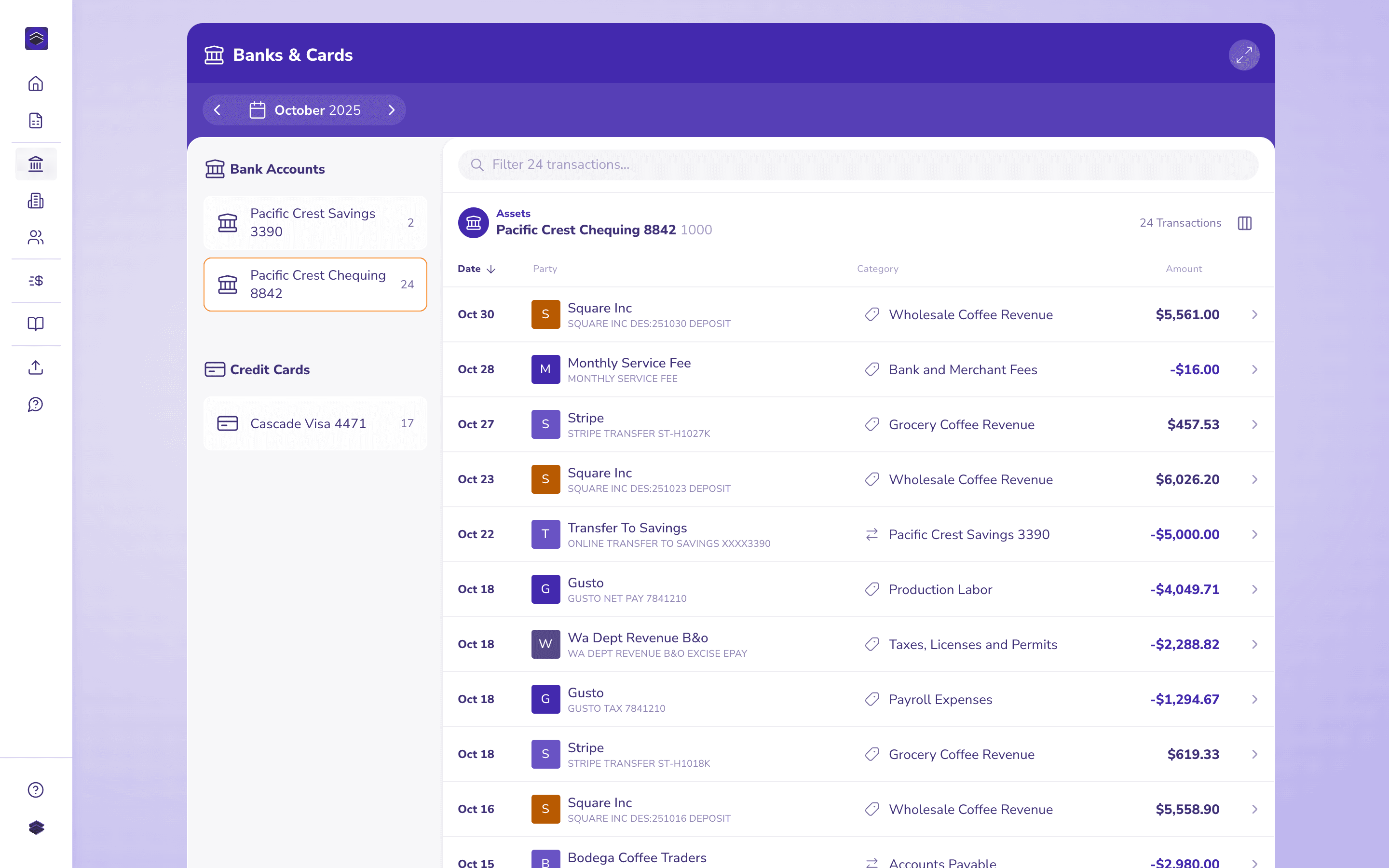
Lakeview Physical Therapy is a fictional two-owner clinic taxed as an S corporation. Its July 2026 checking statement, line by line, and where each line goes:
| Bank statement line | Amount | Booked as |
|---|---|---|
| Insurance EFTs, 5 payers | 18,420.00 | Patient service revenue › Insurance |
| Card processor deposits | 4,862.35 | Patient payments 5,010.00 less merchant fees 147.65 |
| Refund to patient, overpaid copay | (85.00) | Patient refunds |
| Equipment loan payment | (1,286.40) | Loan principal 1,104.15, interest expense 182.25 |
| Payroll, net pay | (21,300.00) | Wages, from the payroll report |
| Payroll taxes | (7,140.00) | Withholdings owed and employer payroll taxes |
| Transfer to owner | (5,000.00) | Owner distributions, not an expense |
Revenue for July is 18,420.00 + 5,010.00 − 85.00 = 23,345.00, which is 147.65 more than the 23,197.35 those three lines added to the bank, because the processor kept its fees before paying out. Of the 1,286.40 loan payment only 182.25 reaches the profit and loss. The 5,000.00 to an owner does not reach it at all.
WHAT WE NEED
What does a bookkeeper need from a medical practice each month?
No patient charts. The books are built from financial documents only.
Bank and card statements
Every operating account and every card, as PDFs, each month.
The card processor’s monthly statement
It shows gross payments and fees, which turn net deposits back into revenue and cost.
The payroll report
Gross wages, withholdings and employer taxes for each pay run, from your payroll provider.
Loan and lease statements
For the principal and interest split on each equipment payment.
A deposit summary by payer, if you want it
Totals by payer from your billing system, if you want revenue split by insurer. Totals only; no patient names are needed.
WITH ZERABOOKS
How does ZeraBooks keep a medical practice’s books?
Our team does the books on ZeraBooks, our own AI-native ledger. You keep running the clinic.
- 1
A free call
Accounts, payers, processor, payroll provider, how owners are paid. We agree the monthly price, and quote any months behind separately.
- 2
Upload each month
Statements and reports go into your upload portal. There is no bank feed and no connection to your billing or EHR system.
- 3
Every account proven to the statement
Each month closes only when the books match the bank and card statements to the cent. Processor deposits are grossed up and loan payments split before it does.
- 4
Reports on your schedule
Profit and loss, balance sheet and cash flow, with revenue by insurance and patient payments. You and your accountant see them in a read-only login.
- 5
Owner pay kept straight
Salary through payroll and distributions as equity, so your accountant can check the split at year-end. See bookkeeper vs accountant for who handles which part.
How much does bookkeeping for a medical practice cost?
ZeraBooks starts from $150 a month (USD). A clinic with several accounts, payers and a payroll usually costs more than that, and the price is agreed after a free call. See what a bookkeeper costs for how other options compare.
Do you do medical billing or insurance claims?
No. ZeraBooks keeps the practice’s books. Claims, coding and patient statements stay with your billing team or billing company.
Do you need access to patient information?
No. Bank and card statements, the processor statement, payroll reports and loan statements are enough. If you send a deposit summary by payer, totals are all we need.
Should a practice use cash or accrual bookkeeping?
Most small practices keep the books on the cash basis, recording revenue when payers and patients pay. Accrual books record it when the visit happens, which needs your billing system’s receivables. Ask your accountant which your returns use.
Is this the same as bookkeeping for a dental office or a physical therapy clinic?
Yes. Dental, physical therapy, chiropractic and specialist practices share the same pattern of payer deposits, card payments, financed equipment and staff payroll. Some practice owners also set up as startups first; see bookkeeping for startups.
Can we keep the books ourselves?
Yes. ZeraBooks AI bookkeeping reads your statements, categorizes from your history and reconciles each month, from $79 a month billed annually after a 7-day trial. Locum or contract clinicians paid on a 1099 are handled the way bookkeeping for contractors handles subcontractors: a W-9 first, then a year-end total.
WE DO YOUR BOOKS
Send us last month’s statements.
We’ll show you what the deposits really were.
Tell us your accounts, your processor and your payroll provider. We quote the monthly price before work starts. Book the free call.
Last updated October 19, 2026 · Written by Damin Mutti, founder of ZeraBooks