IOLTA trust accounting: the three-way reconciliation, worked by hand.
IOLTA trust accounting keeps three records of client money in step: the trust bank statement, the firm’s trust journal and a ledger for each client. A three-way reconciliation adjusts the bank balance for outstanding items, then shows all three agree on one date. Many state bars require it monthly. See bookkeeping for law firms for the rest of the books.
7-day trial · card required, nothing charged for 7 days · then $79/month billed annually or $149 monthly
DEFINITION
What is an IOLTA?
Interest on Lawyers’ Trust Accounts: a pooled, interest-bearing trust account for client money that is too small or held too briefly to earn the client net interest. The bank pays the interest to the state’s IOLTA program, which funds legal aid.
THE THREE RECORDS
What are the three parts of a three-way reconciliation?
Each record is kept separately, so each can catch a mistake in the other two.
The trust bank statement
What the bank says is in the IOLTA account at month end. On its own it is incomplete, because checks you have written may not have been cashed yet.
The trust journal
The firm’s running register of every deposit and disbursement in the trust account, in date order. In a general ledger it is the trust bank account and the matching liability to clients.
The client ledgers
One running balance per client or matter. Every trust deposit and disbursement is posted to exactly one of them, and none may ever go below zero.
The adjusted bank balance
The statement balance plus deposits in transit, less outstanding checks. This is the bank’s number made comparable with the other two.
Try it on your own documents. One-week free trial, both apps included.
Same order every month, using the statement’s closing date for all three records.
1
Reconcile the bank to the trust journal
Tick every statement line against the journal. List deposits recorded but not yet on the statement, and checks written but not yet cleared. The method is the same as an ordinary bank reconciliation.
2
Work out the adjusted bank balance
Statement balance, plus deposits in transit, less outstanding checks. It must equal the trust journal balance.
3
Total the client ledgers
List every client with money in trust and add their balances. Flag any client below zero; that alone is a problem to fix today.
4
Compare all three
Adjusted bank, trust journal and client ledger total must be the same figure, to the cent.
5
Find and fix any difference
Correct the record that is wrong, not the one that is easiest to change. Write down what it was.
6
Sign, date and keep it
Keep the reconciliation with the statement and the client ledger listing. These are the first records a trust account audit asks for.
WORKED EXAMPLE
What does a three-way reconciliation example look like?
Brennan Law is a fictional two-lawyer firm. Its IOLTA account statement for June 2026 closes at 48,315.00. Here are the three numbers on June 30:
Record
Item
Amount
Bank
Statement closing balance, June 30
48,315.00
Bank
Add: deposit in transit, Lopez retainer
6,000.00
Bank
Less: check 2214, court reporter for Nguyen
(1,215.00)
Bank
Less: check 2216, Ward’s share of settlement
(12,500.00)
Bank
Adjusted bank balance
40,600.00
Trust journal
Register balance, June 30
40,600.00
Client ledgers
Lopez
6,000.00
Client ledgers
Nguyen
3,785.00
Client ledgers
Ward
18,315.00
Client ledgers
Ostrowski
12,500.00
Client ledgers
Total of client ledgers
40,600.00
All three agree at 40,600.00, so June reconciles. The Lopez retainer was deposited after the bank’s cutoff on June 30. Checks 2214 and 2216 were mailed in the last week of June and cashed in July; both were already deducted from the clients’ ledgers when written, which is right.
WHEN IT DIDN’T TIE
What if the client ledgers don’t match the trust account?
On the first pass, Brennan Law’s client ledgers totaled 40,750.00, which is 150.00 more than the bank and the journal.
Two records agree, one doesn’t
Bank and journal both said 40,600.00, so the error was in the client ledgers. When the bank and the client ledgers agree instead, look at the journal.
The difference is one transaction
150.00 matched check 2211, a refund of unused costs to Ostrowski that cleared on June 12. It was in the journal and on the statement, but never posted to her client ledger, so her balance showed 12,650.00.
The fix
Post check 2211 to the Ostrowski ledger. Her balance becomes 12,500.00 and the total becomes 40,600.00. Nothing changes in the bank or the journal.
Other common causes
A deposit posted to the wrong client, a fee moved to operating before it was billed, a bank charge taken from trust, or an earned fee still sitting in trust. Each one shows up as a mismatch between the records.
A client below zero
Even when the totals agree, a negative client ledger means one client’s money paid another’s costs. The firm replaces the shortfall from its own funds and finds out how it happened.
WHAT TO KEEP
What records does IOLTA trust accounting require?
Each state sets its own rules, most built on ABA Model Rule 1.15, which asks for complete trust records kept five years after the representation ends. Check your state bar’s rule for the exact list and how often to reconcile.
Monthly trust bank statements
With images of cleared checks and deposit records where the bank provides them.
The trust journal
Every deposit and disbursement, with date, payer or payee, client and purpose.
A ledger for every client
Including closed matters, which should end at exactly zero.
Each reconciliation, signed
The adjusted bank balance, the journal balance and the client listing, with what was fixed. Like a balance sheet reconciliation, it proves an account against outside support.
WITH ZERABOOKS
Where ZeraBooks fits in trust accounting.
ZeraBooks keeps two of the three records. The client ledgers stay in your trust accounting or practice management software.
BANK AND JOURNAL
The trust account proven every month.
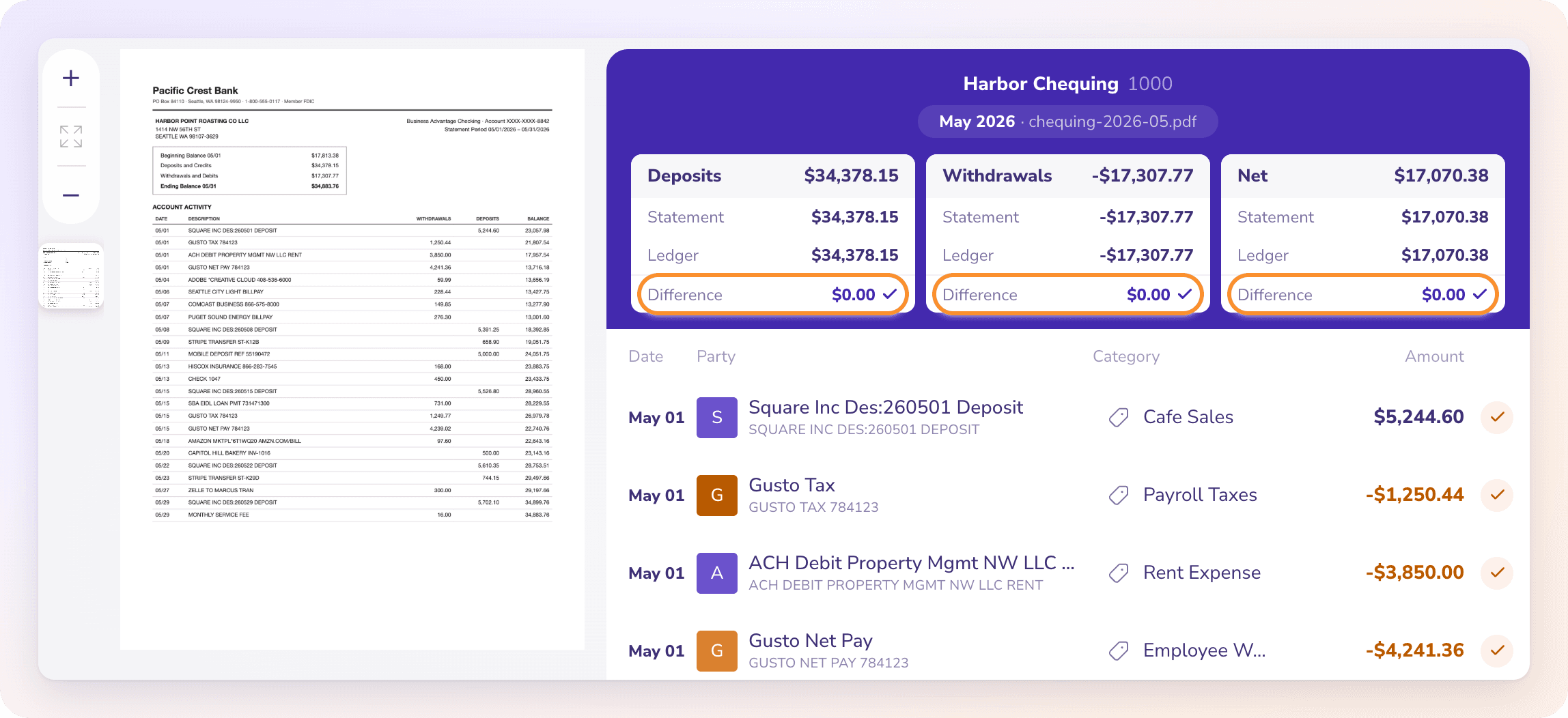
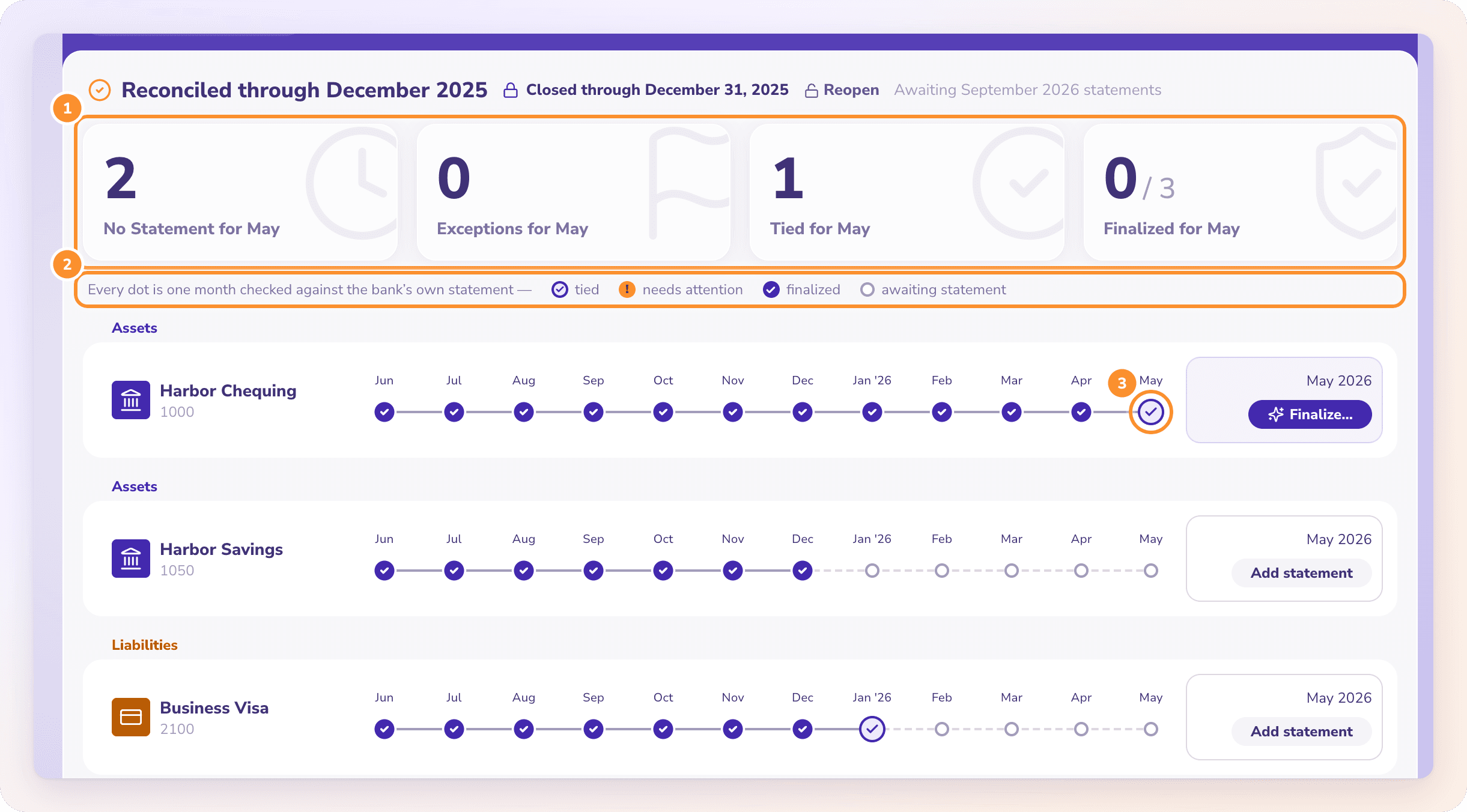
Upload the IOLTA statement and ZeraBooks checks it adds up, follows last month’s statement and agrees with the trust account and the client trust funds liability in the ledger. That covers the bank-to-journal leg of the reconciliation. Part of AI bookkeeping in ZeraBooks.
CLIENT LEDGERS
You bring the third number.
ZeraBooks does not keep a ledger per client. Compare the client trust funds balance with your client ledger total each month, then close the month in ZeraBooks so the reconciled figures stay put.
How often do you need to do a three-way reconciliation?+
It depends on your state. Many state bars require it monthly and some quarterly. Monthly is the safer habit, because a mistake found a month later is one month of entries to search, not three.
Is an IOLTA account the same as a client trust account?+
An IOLTA is one kind of client trust account: pooled, with the interest going to the state program. A large or long-held sum for one client usually goes in a separate trust account where the interest belongs to that client. Both need the same three-way reconciliation.
Does the IOLTA interest go in the firm’s books?+
No. The bank pays it to the state IOLTA program. It is not the firm’s income and not a client’s money, so it is never booked as revenue.
Can a three-way reconciliation be done in a spreadsheet?+
Yes. The worked example above is the layout: the bank section, the journal balance and the client listing, each totaled. What matters is that the client ledgers and the journal are kept from the same transactions every month.
Can ZeraBooks keep my law firm’s books, trust account included?+
ZeraBooks keeps the operating and trust accounts and proves both against the statements, from $79 a month billed annually after a 7-day trial. If you would rather hand it over, ZeraBooks bookkeeping services do the firm’s monthly books.