Law firm accounting software, with every trust transfer booked on both sides.
Law firm accounting software has to keep client trust money apart, record each earned-fee transfer from trust to operating on both sides, and prove both bank accounts every month. ZeraBooks is a general ledger with AI bookkeeping that does this from your uploaded statements and pairs the two sides of each transfer. Per-client ledgers stay in your practice software.
A liability account in the firm’s books equal to all the client money sitting in the trust or IOLTA bank account. It goes up when a client deposits money and down when money is paid out for the client or moved to operating as an earned fee.
THE REQUIREMENTS
What does a law firm need from accounting software?
Most of a firm’s books look like any small business. The difference is that one bank account holds money the firm doesn’t own.
Two kinds of money, never mixed
The operating account is the firm’s. The trust or IOLTA account belongs to clients. The software has to show both, and show that trust money never paid a firm expense.
A liability that mirrors the trust bank
Every dollar in the trust account is owed to someone. The books need a Client trust funds liability that always equals the trust bank balance.
Earned fees moved correctly
When a fee is earned and billed, the firm moves it from trust to operating. That one move has to reduce what the firm owes clients and record fee income at the same time.
Costs advanced for clients
Filing fees, court reporters and expert retainers the firm pays from operating are owed back by the client. They sit as an asset until reimbursed, not as an expense.
Monthly proof
Both bank accounts reconciled to their statements every month, so the trust side of a three-way reconciliation starts from a bank balance that is right to the cent.
We set you up and catch up your past months for free. Then ZeraBooks keeps your books done.
How do you record a transfer from trust to operating?
Okafor & Lind LLP is a fictional firm. Its IOLTA account held 22,600.00 of client money on April 1. Here is one client’s retainer, a cost the firm advanced, and the transfer once the April invoice went out.
Date
What happened
Debit
Credit
Amount
Apr 3
Patel pays a retainer into trust
IOLTA ...4417
Client trust funds
5,000.00
Apr 12
Firm pays Patel’s filing fee from operating
Client costs advanced
Operating ...2290
410.00
Apr 30
Invoice 1182: fees 3,240.00 + filing fee 410.00
No entry yet
No entry yet
3,650.00
May 2
Transfer from trust to operating (from both statements)
Operating ...2290
IOLTA ...4417
3,650.00
May 2
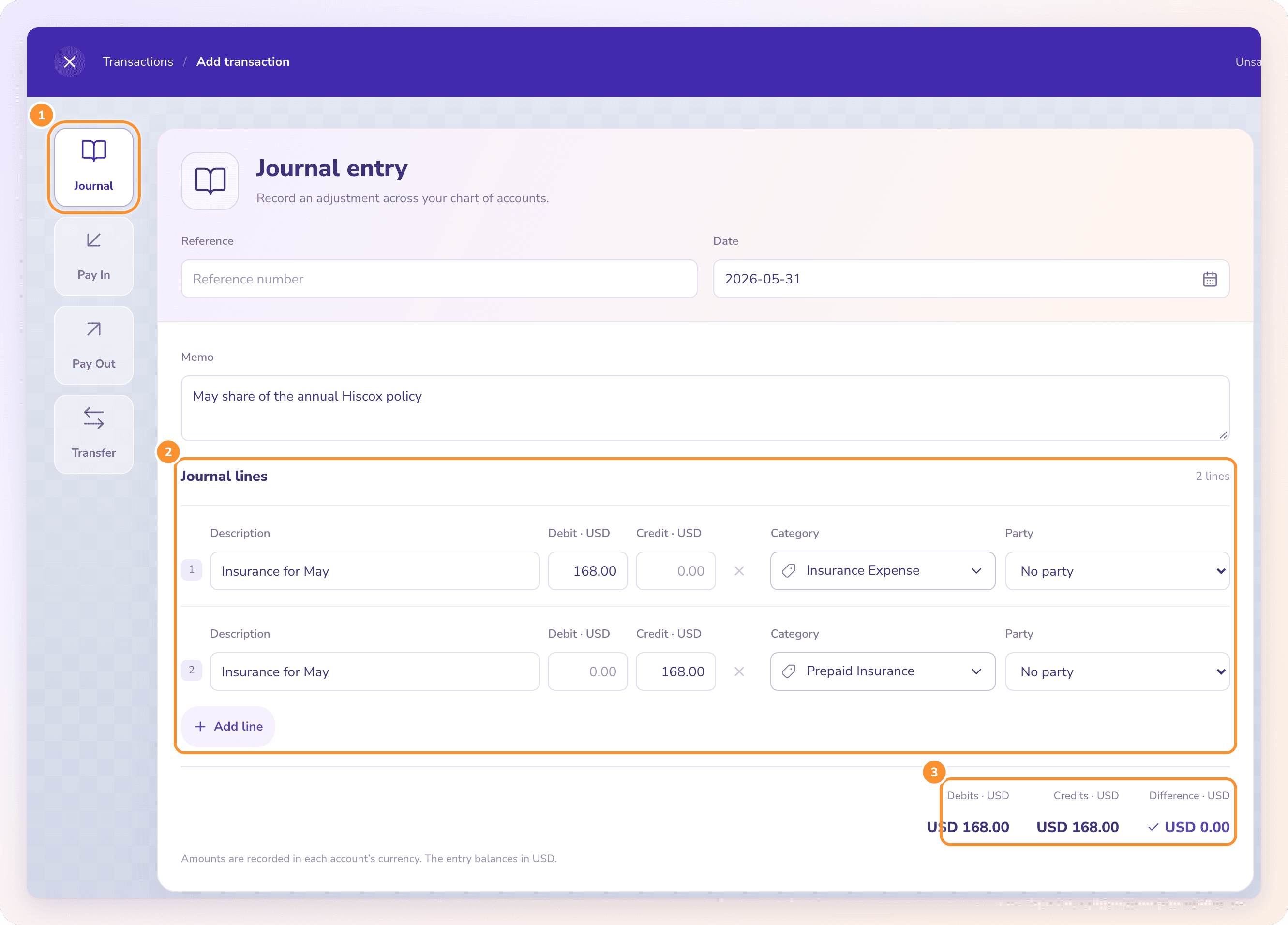
Journal entry: the client money becomes the firm’s
Client trust funds
Legal fee income
3,240.00
May 2
Same journal entry, second credit line
Client costs advanced
410.00
May 2
Journal entry total (3,240.00 + 410.00)
Client trust funds
3,650.00
The transfer alone only moves cash between the two bank accounts. Without the journal entry, Client trust funds would still say the firm owes clients 27,600.00 while the IOLTA account holds 23,950.00. After it: IOLTA 22,600.00 + 5,000.00 − 3,650.00 = 23,950.00, Client trust funds the same 23,950.00, Patel’s client ledger 1,350.00, Client costs advanced back to 0.00, and operating up 3,240.00, which is exactly the fee income.
WHAT GOES WHERE
Which law firm transactions are income, and which are not?
Most posting mistakes at a firm come from treating client money as revenue. A quick reference for the common ones.
Transaction
Bank account
Category
Income?
Retainer or advance fee received
Trust
Client trust funds (liability)
No, not until earned
Earned fee moved to operating
Trust to operating
Transfer, plus the journal entry above
Yes, when moved
Flat fee paid after the work is done
Operating
Legal fee income
Yes
Filing fee paid for a client
Operating
Client costs advanced (asset)
No
Settlement received for a client
Trust
Client trust funds
No
Settlement share paid to the client
Trust
Client trust funds
No
Bank service charge on the trust account
Trust
Bank fees (paid with firm money kept there for charges)
No, an expense
IOLTA interest
Trust
Not the firm’s; the bank sends it to the state program
No
Rules on which costs a firm may pay from trust, and how quickly earned fees must leave it, come from your state’s version of ABA Model Rule 1.15. Check your state bar’s trust account handbook.
SETUP
How to set up a law firm’s books in ZeraBooks
About an hour for a firm with an operating account, a trust account and a card.
1
Add both bank accounts
In Banks & Cards, add the operating account and the IOLTA account by name, such as “IOLTA 4417”, plus any firm credit card.
2
Generate the chart of accounts
In Accounting › Category Manager, click Generate with AI and describe the firm, for example “two-partner litigation firm with an IOLTA account”. Before saving, make sure the draft has Client trust funds under Liabilities and Client costs advanced under Assets.
3
Bring the trust balance across
If you are moving from other software, import the closing trial balance so Client trust funds starts equal to the trust bank balance.
4
Upload both statements every month
Each statement is read and checked against its printed balances. When both sides of a trust-to-operating transfer are in, ZeraBooks pairs them.
5
Book the transfer journal entry
For each transfer, add a journal entry from your practice software’s invoice: debit Client trust funds, credit Legal fee income and Client costs advanced.
6
Reconcile and close
Finalize the month in Reconciliations once both accounts tie, then compare Client trust funds with the client ledger total from your practice software.
WHAT TO WATCH
What trust accounting mistakes should the books catch?
A general ledger can’t stop a wrong transfer, but a firm that books every transfer as above will see these the same month.
Transfers before the invoice
Money moved to operating before the fee is earned and billed. The journal entry has no invoice to point to, which is the warning.
Round-number transfers
Moving 5,000.00 “to cover payroll” instead of the exact invoiced amount. The Client trust funds balance drifts away from the client ledgers.
Earned fees left in trust
Fees billed but never moved are the firm’s money sitting in a client account, which most states treat as commingling.
Firm bills paid from trust
A supplier or rent payment from the IOLTA account. On the trust statement it shows up as a line with no client behind it.
A client ledger below zero
Paying out more for a client than they deposited spends another client’s money. Your practice software’s client ledger shows it; the books show the total.
WHERE ZERABOOKS FITS
The firm’s ledger, proven every month.
ZeraBooks keeps the general ledger for both accounts. Client-by-client trust ledgers, time and billing stay in your practice management software, and statements are uploaded rather than fed from the bank.
THE GENERAL LEDGER
Operating and trust, each tied to its statement.
Every statement has to add up, follow the one before it and agree with the ledger before a month ties. When a trust month doesn’t tie, ZeraBooks shows the difference between statement and ledger, so a missing deposit or a stray payment is found before the state bar asks.
If the partners would rather practise law, the ZeraBooks team keeps the books for you; our guide to bookkeeping for law firms covers what that includes. You upload statements and see the work in a read-only dashboard. From $150 a month (USD), quoted after a free call.
What is the best accounting software for a small law firm?+
One that keeps the trust liability equal to the trust bank, books earned-fee transfers on both sides and proves every account monthly. ZeraBooks does that as an AI-native general ledger, from your uploaded statements, at one price for every feature.
Is a retainer income when it is received?+
Not if it is an advance against future work. It goes into trust and sits in Client trust funds until the fee is earned and billed. Only then does it become fee income, when it moves to operating. Property managers hold tenant deposits the same way; see property management accounting software.
Why isn’t the trust-to-operating transfer enough on its own?+
A transfer between your own accounts moves cash but changes no income or liability. The journal entry is what tells the books the money stopped being the client’s and became the firm’s.
Can ZeraBooks keep a ledger for each client?+
No. ZeraBooks keeps the trust bank account and the total owed to clients. Each client’s running balance stays in your practice management software, and the two totals should match every month.
Does ZeraBooks connect to the firm’s bank or practice software?+
No. Statements for the operating and trust accounts are uploaded as PDF or CSV, and invoices stay in your practice software. ZeraBooks checks each statement against its opening and closing balances.
How much does ZeraBooks cost for a law firm?+
$79 a month billed annually or $149 monthly after a 7-day trial, the same for every business. See ZeraBooks pricing.
Damin founded ZeraBooks in 2025 and still talks to the bookkeepers, firms and owners who use it every week. He writes about what he sees in their statements and ledgers, and every page here is checked against the live product before it goes up.
Upload last month’s trust and operating statements. See both accounts tie.
Add the two accounts, upload one month and book the transfers. 7 days, then $79 a month billed annually. Rather have the books kept for you? See bookkeeping services.