Bookkeeping cleanup, proven against every statement.
A bookkeeping cleanup fixes books that were kept but are wrong: accounts never reconciled, lines left uncategorized, deposits entered twice, transfers booked as income. The work runs account by account, oldest month first, until each month agrees with the bank statement. ZeraBooks bookkeeping services quote a cleanup after a free call and prove every month against the printed balances.
Free call · the cleanup scoped and quoted before work starts · watch each month tie in your read-only login
DEFINITION
What is a bookkeeping cleanup?
A bookkeeping cleanup is a one-time project that corrects a business’s existing books: reconciling every bank and card account to its statements, fixing miscategorized and duplicate entries, and correcting opening balances, so the financial reports can be relied on again.
CLEANUP OR CATCH-UP
What is the difference between a cleanup and catch-up bookkeeping?
A cleanup corrects books that exist. Catch-up bookkeeping records months that were never entered. Most businesses that are behind need some of each.
Compared on
Cleanup
Catch-up
Starting point
Books exist but the numbers are wrong
Nothing entered since a certain month
The main work
Finding and reversing mistakes, then reconciling
Recording every transaction from the statements, then reconciling
Usual sign
The software’s bank balance disagrees with the bank
The last reconciled month is a long way back
Where it ends
Every month ties to its statement
Every month ties to its statement
Tell us about your books. We’ll scope the work and quote it before anything starts.
Order matters because each step depends on the one before. Categorizing a month that doesn’t reconcile yet is work you may have to redo.
1
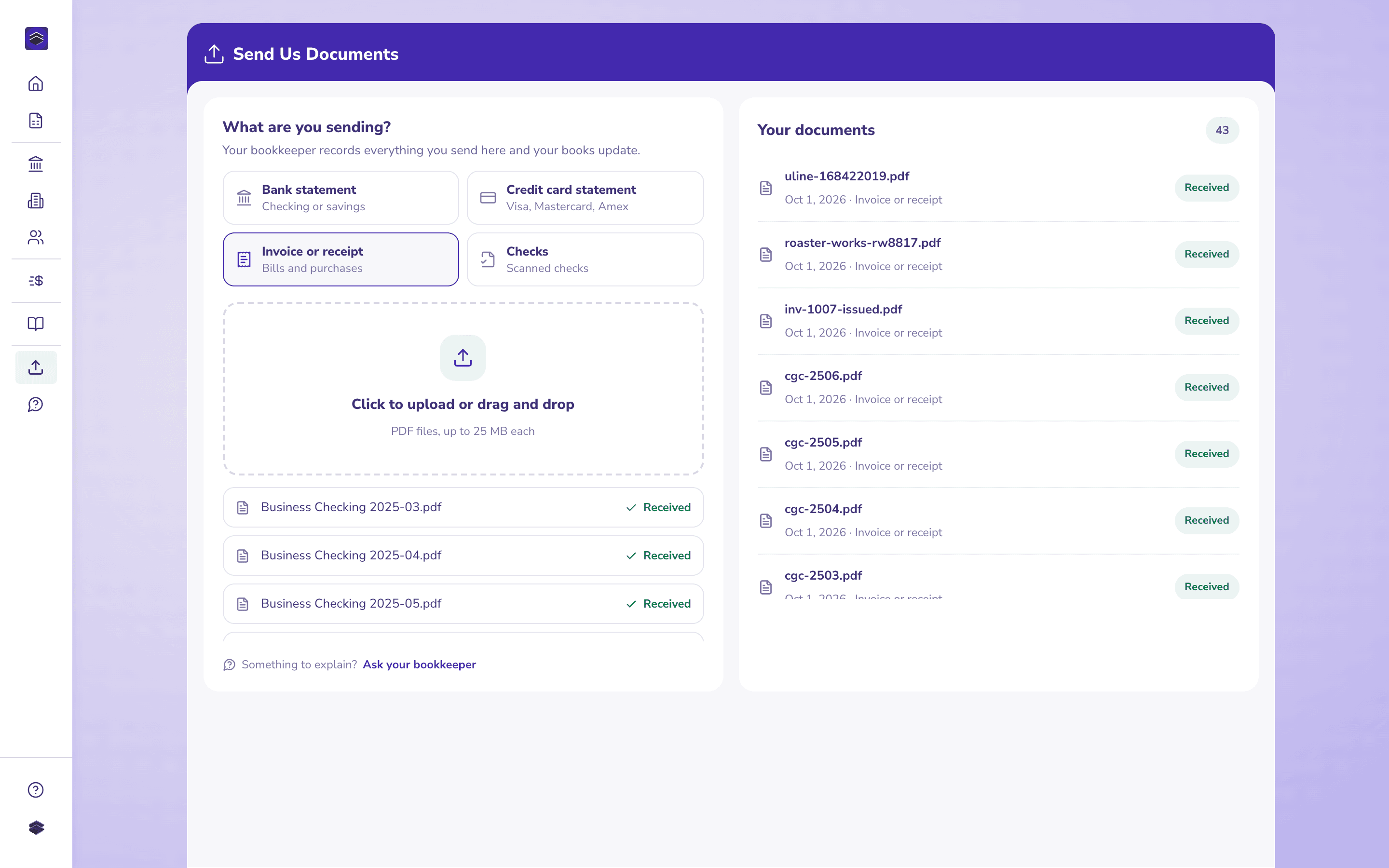
Gather every statement
Bank, credit card and loan statements for every account, every month, from the last month you trust to today. A month without its statement can’t be proven, so gaps are found first. Our guides to downloading statements cover the big banks.
2
Set the opening balances
Pick a start date where the balance sheet is known to be right, usually the last year end your accountant signed off. Each account’s opening balance must equal that date’s statement balance.
3
Reconcile each account, oldest month first
Each month must add up from opening to closing balance, start where the last month ended and agree with the ledger. A month that won’t tie usually points to a missing line, a duplicate or a misread balance.
4
Pair transfers and remove duplicates
Money moved between your own accounts, and credit card payments, are transfers, not income or expenses. A deposit entered by hand and again from the statement is counted once. How ZeraBooks spots each kind is in transfers, card payments and owner draws.
5
Clear uncategorized and suspense
Every line gets a real account. The ones no document explains, such as a cash withdrawal or a transfer to a person, go on one list of questions for the owner.
6
Separate owner draws
Personal spending on the business card and money taken out for the owner move out of expenses and into owner draws, which lowers expenses and leaves profit higher than the old books showed.
7
Review and hand over
The reports for each cleaned month are checked against what the business knows about itself, then delivered with anything still open, such as a statement the bank hasn’t sent.
RED FLAGS
What are the signs your books need a cleanup?
Any one of these means the reports can’t be trusted as they stand.
The bank balance in the books isn’t the bank balance
If the ledger balance for checking on the last day of a month differs from that month’s statement, something is missing, doubled or wrong.
A big Uncategorized or Ask My Accountant balance
Lines parked there sit outside every real expense and income line, so the profit and loss is wrong by that amount.
Revenue higher than the deposits explain
Transfers from savings, loan proceeds and owner contributions booked as sales make the business look busier, and can raise its tax bill.
Card payments booked as expenses
The charges were already expenses on the card. Booking the payment as an expense too counts the same spending twice.
Balances that can’t be right
A negative balance on a savings account or inventory, a credit card with a debit balance, or Opening Balance Equity that changes every month.
Your accountant sent the year end back
A list of questions at tax time usually means the same unresolved items have been carried for months.
WORKED EXAMPLE
Example: cleaning up books nine months behind
A fictional landscaping company with a checking account, a savings account and one business card. The accountant signed off December. The owner entered January to March himself without reconciling, then stopped. April to September were never entered. That is 27 statements: 3 accounts for 9 months. January to March needed a cleanup and April to September a catch-up. What the cleanup found in January to March:
What was found
Amount
The fix
Savings-to-checking transfers booked as sales
12,000.00
Reclassed as transfers, so sales fall by 12,000.00
A customer deposit entered by hand and imported from the statement
3,150.00
One copy removed
Card payments booked as office expenses
6,840.00
Reclassed as transfers to the card
Equipment loan payments booked in full as expense
4,500.00
Split: 3,780.00 principal to the loan, 720.00 interest to interest expense
Owner’s personal charges on the business card
2,275.60
Moved to owner draws
Lines in Uncategorized (146 lines)
18,412.37
Categorized, after the owner answered 9 questions
Savings statement for June missing
Requested from the bank. June and July savings stayed open until it arrived
Sales were overstated by 15,150.00 and expenses by 12,895.60, so January to March profit fell by 2,254.40 before the uncategorized lines were placed. The owner had planned his estimated tax payments on the old figure.
TIME AND DELIVERABLE
How long does a bookkeeping cleanup take, and what do you get?
The work itself depends on the number of accounts, the number of months and how tangled the old entries are. The wait is usually somewhere else: collecting statements the owner doesn’t have and getting answers to the questions only the owner can answer. Once every document is in, ZeraBooks does catch-up work in days, and the timeline is set in your quote before work starts.
At the end, each bank and card account has every month reconciled to its statement and signed off, with the books closed through the last month so nothing changes by accident. You get the profit and loss, balance sheet and cash flow for the period, and a short note of anything still open. You can see all of it in your read-only login as each month is done, not only at the end.
HOW ZERABOOKS PROVES IT
How does ZeraBooks prove each month during a cleanup?
ZeraBooks reads each statement’s printed opening and closing balances along with its lines, and uses them to prove the month, instead of trusting the old books. It has no bank feed, so the statements are the source.
THE THREE CHECKS
A month ties only when all three agree.
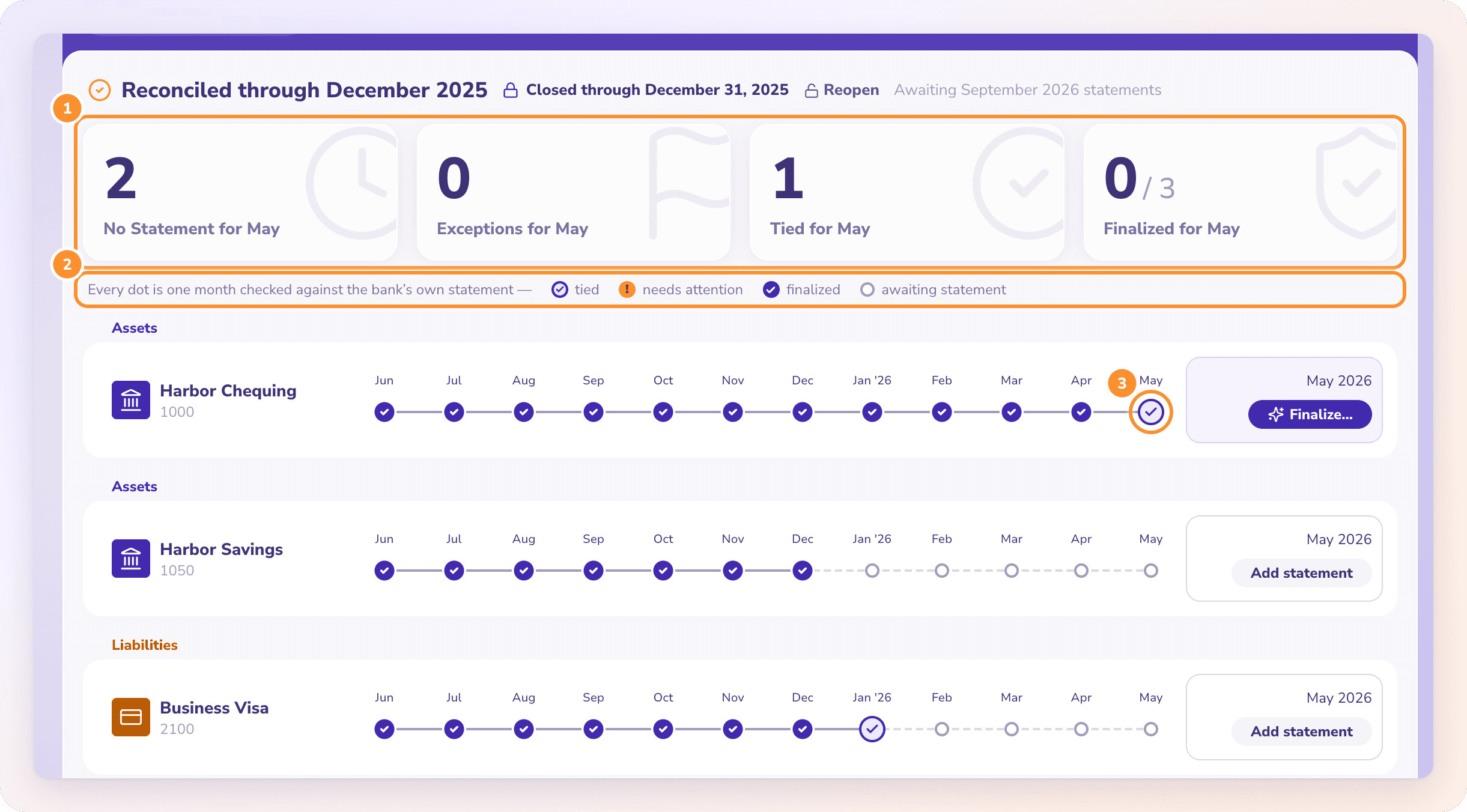
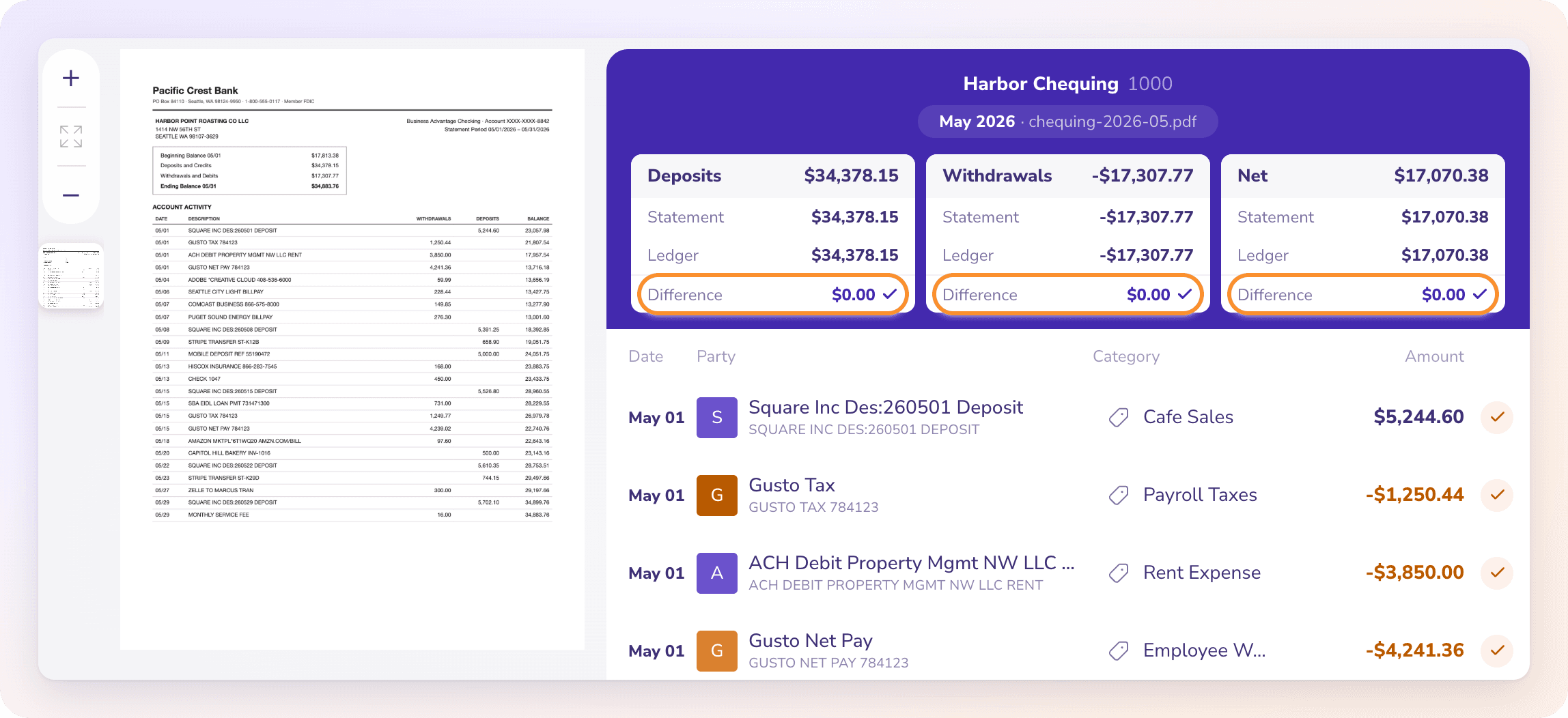
The statement must add up from opening to closing balance, its opening balance must equal the previous statement’s closing balance, and the ledger must equal the printed closing balance. A month can only be finalized once all three pass. The same checks run in our bank reconciliation software, which you can use to keep the books yourself after the cleanup.
A chain break shows a missing month or a misread balance
A coverage gap shows days no statement covers
A statement or line uploaded twice is refused
Every month that still needs a look is flagged on the timeline
The difference is shown, then fixed against the document.
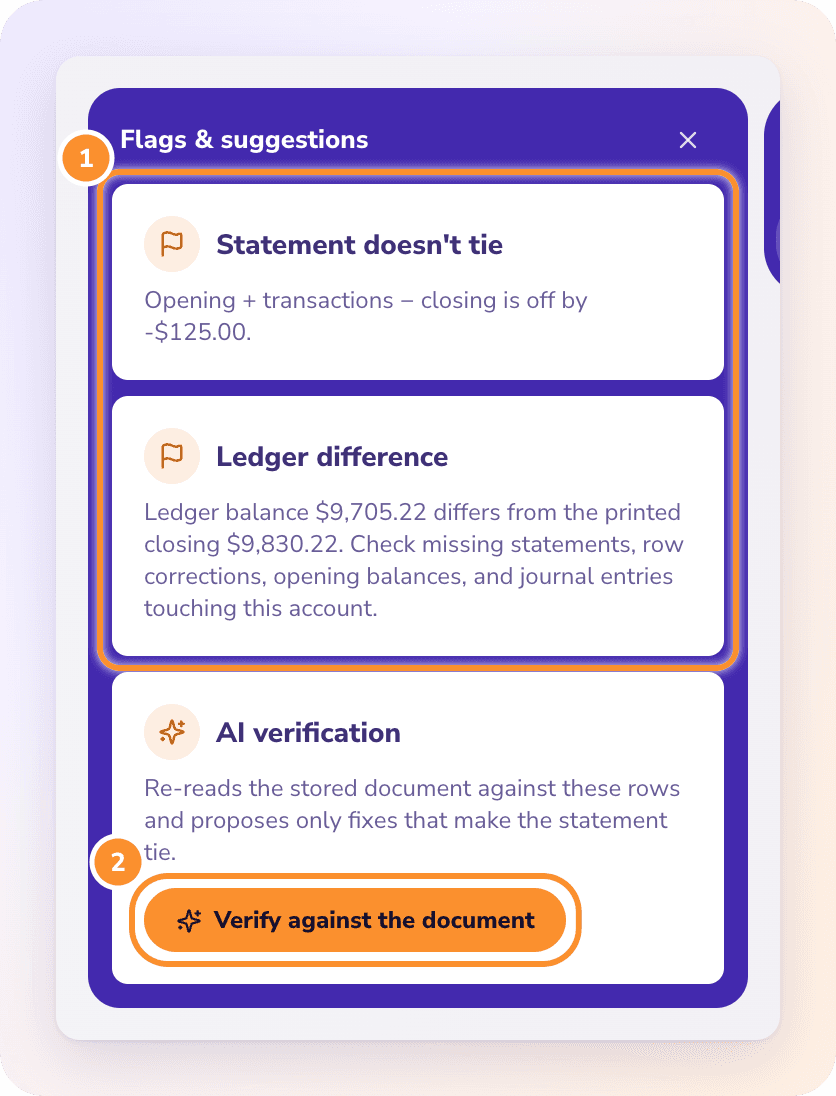
A month that doesn’t tie shows the statement and the ledger side by side with the difference. Verify against the document re-reads the statement and proposes only the fixes that make it tie, each quoting the line it came from. Transfers between your own accounts are paired when the description names the other account, or the same amount is on the other statement within 3 days.
Can an accounting firm hand a client cleanup to ZeraBooks?
Yes. The firm decides how much of the work it hands over and how much it keeps.
Hand over the cleanup, keep the client
ZeraBooks does the cleanup and the firm keeps the client relationship and the final review. Responsibilities, access and the handoff are agreed before work starts.
Or do it yourself across clients
Firms that would rather clean up books in-house can keep every client company in one login with accounting software for accountants. Three client companies are included, then $29 a month each.
Or just get the statements into a spreadsheet
If the cleanup will be done in the firm’s own software, the bank statement converter turns each PDF statement into Excel or CSV, checked against the printed balances first.
Restaurants and other cash-heavy clients
Restaurant books often need a cleanup because tips, sales tax and delivery payouts were booked as sales. Our guide to bookkeeping for restaurants shows where each belongs.
It depends on the number of accounts and months and the state of the old entries, so ZeraBooks quotes each cleanup after a free call and agrees the price before any work starts. Ongoing monthly bookkeeping, if you want it afterwards, is quoted in the same conversation.
Do I need every bank statement for a cleanup?+
Yes, for every account and every month in the cleanup. A month can only be proven against its own statement. Most banks let you download past statements as PDFs from online banking, and ZeraBooks tells you which months are missing.
Can you clean up books kept in QuickBooks or Xero?+
ZeraBooks does the work in its own ledger. It does not log in to or sync with QuickBooks or Xero, and it does not make .qbo or IIF files. If your books need to stay in another system, raise it on the call and the handover is agreed in the quote.
What happens after the cleanup?+
Either ZeraBooks keeps the books monthly and sends reports on your schedule, or you keep them yourself in the AI bookkeeping software for $79 a month billed annually or $149 monthly. Both start from the same cleaned, reconciled months.
Will a cleanup change numbers my accountant already filed?+
It shouldn’t. A cleanup normally starts after the last period your accountant signed off and leaves that period alone. A mistake found inside a year that was already filed is a question for your accountant, who decides whether anything needs amending.