GUIDE · NONPROFIT BOOKKEEPING
Bookkeeping for nonprofits:
restricted money, functional expenses and a 990-ready year.
Bookkeeping for nonprofits means tagging every gift as with or without donor restrictions, splitting every expense between programs, management and fundraising, and reconciling each bank account monthly, so the Form 990 comes straight from the books. ZeraBooks bookkeeping services keep nonprofit books this way on the ZeraBooks general ledger. ZeraBooks does not file the 990.
Free call · a quote for your scope · your own read-only login and upload portal
CHART OF ACCOUNTS
What chart of accounts does a nonprofit need?
A small nonprofit’s chart looks like a business chart with two differences: income is split by donor restriction, and expenses are split by function. In ZeraBooks both splits are sub-categories, because statements have no class or department field.
| Type | Category | What goes in it |
|---|---|---|
| Asset | Operating checking 3310 | Gifts, grant payments and online giving payouts land here; most bills are paid from here |
| Asset | Reserve savings 3318 | Board-designated reserves. A board designation is not a donor restriction, so this money stays without donor restrictions |
| Liability | Refundable advances | Cash received on a conditional grant before the condition is met |
| Equity | Net assets without donor restrictions | Opening balance brought across for unrestricted money |
| Equity | Net assets with donor restrictions | Opening balance brought across for restricted gifts and grants not yet spent |
| Revenue | Contributions › Without donor restrictions | General gifts, event tickets above their fair value, unrestricted grants |
| Revenue | Contributions › With donor restrictions › one per grant or purpose | A sub-category for each restricted gift, such as “Adult tutoring grant 2026” |
| Revenue | In-kind contributions | Donated goods and qualifying donated services at fair value |
| Expense | Each expense › Program, › Management and general, › Fundraising | Salaries, rent and supplies, each with a sub-category per function, matching the three columns of Form 990 Part IX |
| Expense | Salaries › To allocate, Occupancy › To allocate | Holding categories for shared costs until the month-end allocation entry empties them |
Keep one sub-category per restricted grant, not one for all restricted money. When the funder asks how its $15,000 was spent, the answer is that grant’s own lines on the Profit & Loss.
Tell us about your books. We’ll scope the work and quote it before anything starts.
EVERY MONTH
What goes wrong in nonprofit books each month?
Most nonprofit bookkeeping problems come from money that arrives with strings attached or without a statement line of its own.
Restricted grants spent without a trail
A grant restricted to a program is revenue with donor restrictions when it is received or promised. Each dollar spent on that program releases part of the restriction. If the spending goes to a general category, nobody can show the funder where the grant went, and the year-end net asset split has to be rebuilt from receipts.
Conditional grants booked as income
A grant with a barrier the nonprofit must clear, such as matching funds or a number of students served, plus a right for the funder to take the money back, is conditional. Cash received early is a refundable advance, a liability, until the condition is met (ASU 2018-08).
In-kind donations left out
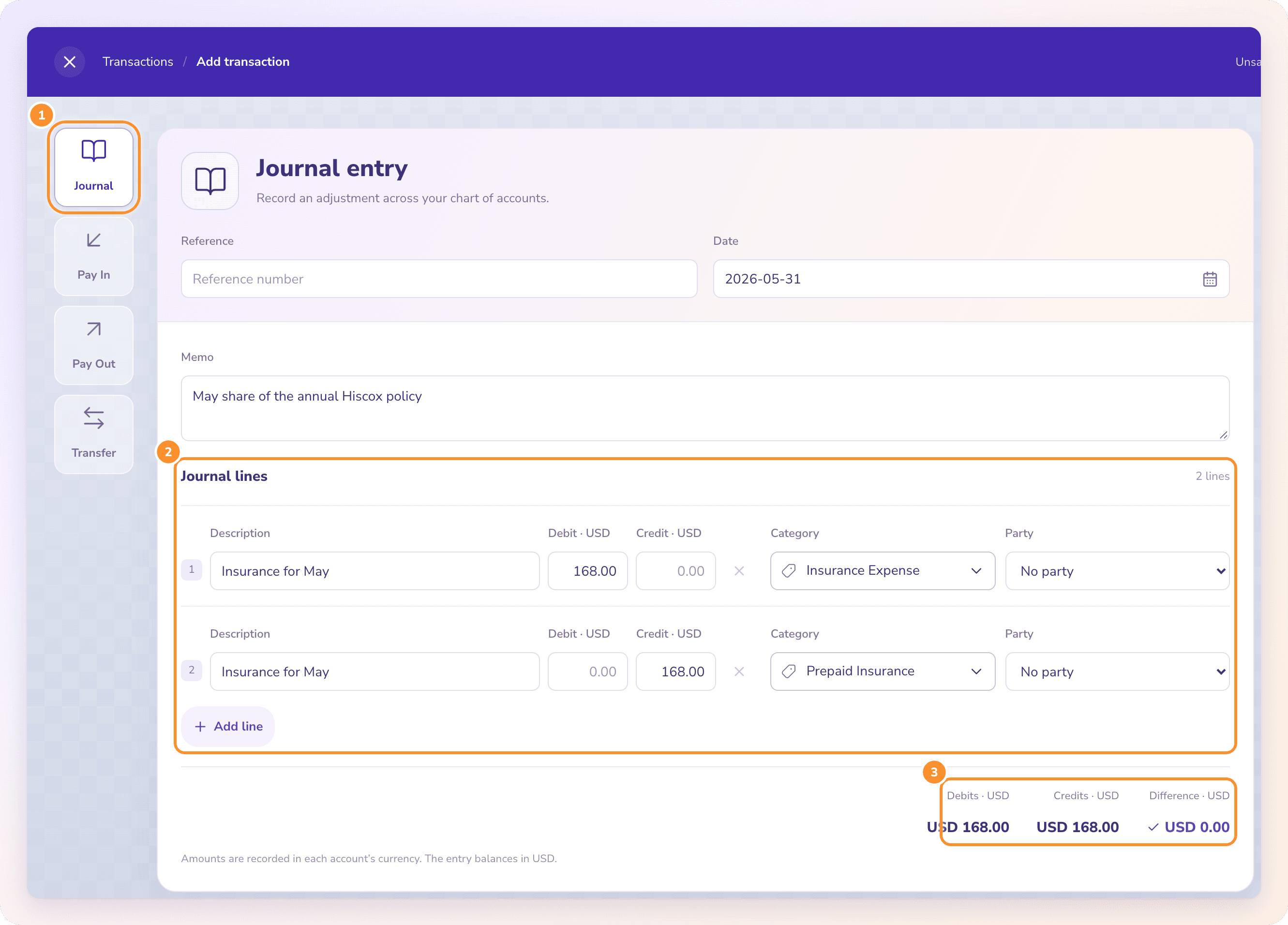
Donated goods have no bank line, so they disappear unless someone records them. Book them at fair value with a journal entry: debit the asset or the expense, credit In-kind contributions. Donated services count only when they need specialized skills, such as a CPA’s audit work, or build or improve an asset. Ordinary volunteer hours are not recorded.
Donor deposits arrive batched
One check deposit can hold fourteen gifts, some restricted. Record the deposit as a Pay In with one line per restriction, using the totals from the deposit slip, then match it to the statement line so it counts once.
Online giving pays out net of fees
A giving platform that keeps its fees before paying out understates both gifts and costs. A monthly journal entry from the platform’s payout report puts the fees back: debit the fee expense, credit Contributions.
Shared costs never allocated
Rent and salaries serve every function. Post them to a To allocate category during the month, then split them with one journal entry using a documented basis, such as timesheets for salaries and floor space for rent. Without it, Form 990 Part IX is a guess.
Gifts that buy something
When a donor pays more than $75 and gets something back, such as a gala dinner, the receipt must state the value of what they received (IRC 6115). In the books, the dinner’s fair value is event revenue and only the rest is a contribution.
WORKED EXAMPLE
Example: one month of a small nonprofit’s books
The Riverbend Literacy Project, a fictional nonprofit with two paid staff, for April. Every cash line comes from the checking statement; the last four rows are journal entries with no bank line.
| Date | What happened | Amount | Category in ZeraBooks | Function or restriction |
|---|---|---|---|---|
| Apr 1 | Rent | (3,000.00) | Occupancy › To allocate | Split on Apr 30 |
| Apr 3 | Foundation grant for adult tutoring, no conditions | 15,000.00 | Contributions › With donor restrictions › Adult tutoring grant | With donor restrictions |
| Apr 6 | Check deposit, 14 gifts | 2,350.00 | Pay In: 1,850.00 to Without donor restrictions, 500.00 to With donor restrictions › Summer reading | Split from the deposit slip |
| Apr 10 | Online giving payout | 4,708.80 | Contributions › Without donor restrictions | Gross $4,860.00 less $151.20 fees |
| Apr 15 | Payroll provider withdrawal | (9,600.00) | Salaries › To allocate | Split on Apr 30 |
| Apr 18 | Tutor stipends | (4,200.00) | Adult tutoring › Stipends › Program | Releases restriction |
| Apr 22 | Workbooks for adult learners | (640.00) | Adult tutoring › Supplies › Program | Releases restriction |
| Apr 24 | Fall gala venue deposit | (800.00) | Events › Fundraising | Fundraising |
| Apr 30 | Journal: donated children’s books, fair value | 1,200.00 | Debit Program supplies › Program, credit In-kind contributions | Program |
| Apr 30 | Journal: giving platform fees | 151.20 | Debit Platform fees › Fundraising, credit Contributions › Without donor restrictions | Fundraising |
| Apr 30 | Journal: salaries by timesheet, 70/20/10 | 9,600.00 | Salaries › Program 6,720.00, › Management and general 1,920.00, › Fundraising 960.00 | All three functions |
| Apr 30 | Journal: rent by floor space, 75/15/10 | 3,000.00 | Occupancy › Program 2,250.00, › Management and general 450.00, › Fundraising 300.00 | All three functions |
April expenses by function: program $15,010.00, management and general $2,370.00, fundraising $2,211.20, total $19,591.20. Revenue was $23,410.00, of which $15,500.00 came with donor restrictions. The tutoring stipends and workbooks released $4,840.00, leaving $10,160.00 of the adult tutoring grant and $500.00 for summer reading still restricted. Without donor restrictions, April ran a deficit of $6,841.20, which the board should see before the gala, not after.
FORM 990
How do monthly books make the Form 990 easier?
Which return a nonprofit files depends on its size. Gross receipts normally of $50,000 or less can file the 990-N e-postcard. Gross receipts under $200,000 and total assets under $500,000 can file the 990-EZ. Anything larger files the full Form 990, due on the 15th day of the fifth month after the year ends, which is May 15 for a calendar year.
The full 990 asks for expenses in three columns: program services, management and general, and fundraising (Part IX). If every expense already sits in a function sub-category, those columns are a sum of Profit & Loss lines. Part VIII wants contributions apart from program service revenue and event income, which the chart above already separates.
Two schedules depend on records the books should keep pointing to. Schedule B lists contributors who gave $5,000 or more in the year, which comes from your donor records, not the ledger. Schedule M is required when noncash gifts total more than $25,000, so the in-kind journal entries need a memo saying what was given.
ZeraBooks does not prepare or file the 990. It gives the preparer a reconciled Profit & Loss and Balance Sheet for the year, downloadable as PDF, CSV or Excel, with every number traceable to the statement line or journal entry behind it.
IN ZERABOOKS
How does ZeraBooks keep a nonprofit’s books?
Our team does this for you as a quoted service, or you can do it yourself in the same software. Either way the month ends with every account tied to its statement.
- 1
Set up restrictions and functions as sub-categories
Start from the nonprofit’s existing chart or generate one with AI from a line such as “a literacy nonprofit with a restricted tutoring grant”, then add the restriction and function sub-categories. See how to add sub-categories.
- 2
Upload every account’s statements
PDF or CSV for checking, savings and any card. ZeraBooks checks each statement adds up and follows the one before it.
- 3
Tell Zera the routine
For example, “Foundation grant deposits go to the restricted grant named in the memo” or “Giving platform payouts are unrestricted contributions”. Ask Zera keeps the rule and categorizes with it.
- 4
Record what the bank can’t show
Split batched deposits as Pay Ins, then post the month-end journal entries for in-kind gifts, platform fees and the shared-cost allocation.
- 5
Reconcile, close and send the board its report
Close the month once each account ties, then send the Profit & Loss with the function and restriction lines, and the Balance Sheet.
Can a nonprofit use regular bookkeeping software?
Yes, for a small one. A general ledger handles restrictions and functions through sub-categories, which works with a handful of grants. Nonprofits with many funders, federal grants or an audit requirement usually need fund accounting software that carries a fund on every transaction.
Does ZeraBooks produce a statement of functional expenses or a statement of activities?
No. ZeraBooks uses business report names: Profit & Loss, Balance Sheet and Cash Flow. With function sub-categories, the Profit & Loss holds every number a statement of functional expenses needs, and the preparer lays it out in nonprofit format.
Does ZeraBooks track donors or send gift receipts?
No. Keep donors and their receipts in your donor management tool. ZeraBooks records each deposit and how much of it was restricted.
Does ZeraBooks file Form 990?
No. ZeraBooks keeps the books the 990 is prepared from. Your preparer or CPA files the return.
We are a church. Is this the same?
Churches follow much of the same routine but usually think in funds rather than grants, and churches don’t have to file a Form 990. Our guide to church accounting software covers funds and Sunday offerings.
Our treasurer only needs the year’s bank statements in Excel. Can ZeraBooks do that?
Yes. The bank statement converter turns PDF statements into Excel or CSV, checked against the printed balances, without keeping the books in ZeraBooks.
How much does nonprofit bookkeeping cost with ZeraBooks?
Bookkeeping done by our team is quoted after a free call, based on accounts, volume and any catch-up work. Keeping the books yourself in the software is $79 a month billed annually or $149 monthly, after a 7-day trial; see ZeraBooks pricing. Firms that also hold client money should read bookkeeping for law firms.
WE DO YOUR BOOKS
Send us last year’s statements and grant letters.
We’ll quote the books before any work starts.
Tell us how many accounts and restricted grants you have and when the board meets. You keep a read-only login to see every entry as it is made.
Last updated October 14, 2026 · Written by Damin Mutti, founder of ZeraBooks