The AI Accountant: What It Does and Whether You Still Need a CPA
An honest read on what AI replaces in the accounting workflow, what your CPA still owns, and how modern firms run an AI bookkeeping stack on a single platform.
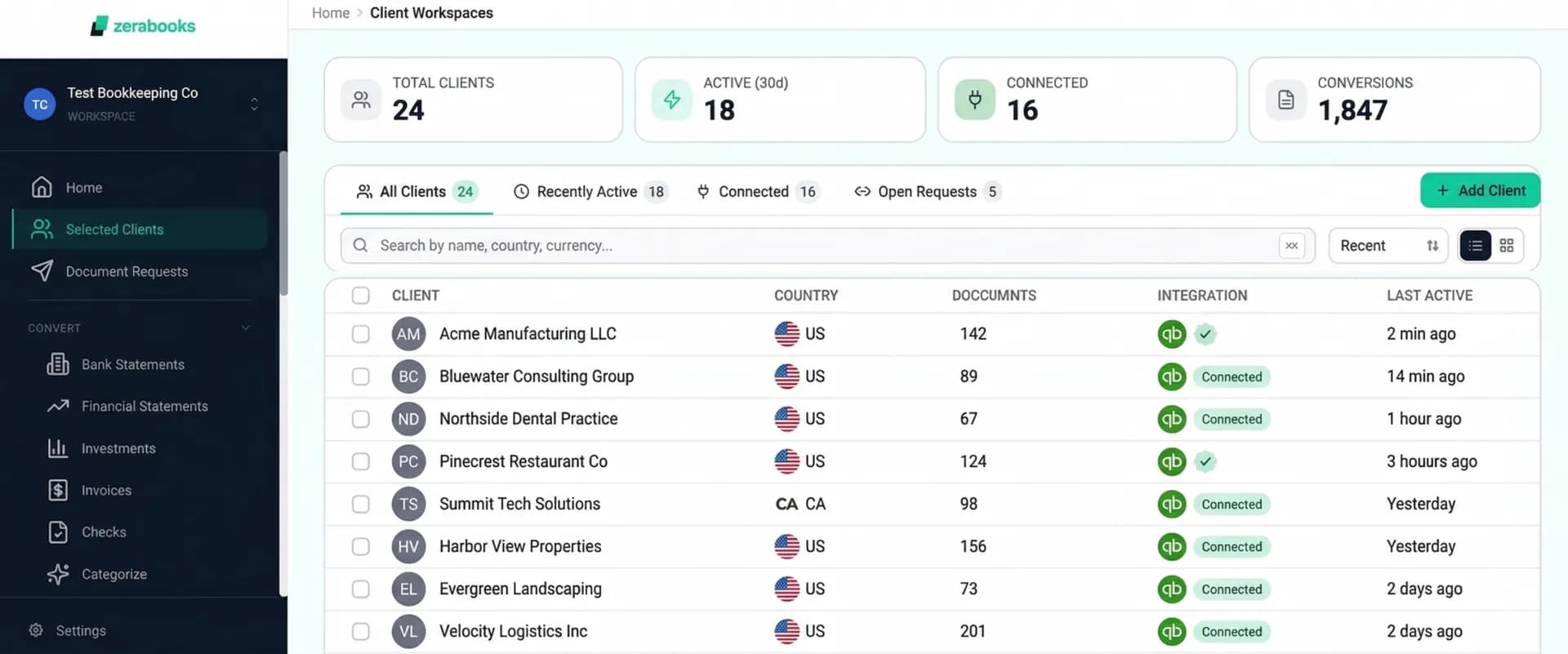
An AI accountant is software that reads source documents, codes transactions to a chart of accounts, and posts double-entry journal entries with a full audit trail. Zera Books delivers 99.6% extraction accuracy across 3.2M+ documents at $79 flat per month. It replaces data entry, not your CPA.
By Damin Mutti, founder of Zera Books. Last reviewed 2026-05-20.
Pricing source for competitor context: Intuit QuickBooks Online pricing. Labor data: BLS Accountants and Auditors.
What is an AI accountant?
An AI accountant is a software system that performs the mechanical layers of accounting work: reading source documents, classifying each line against a chart of accounts, posting balanced journal entries, and producing financial statements. It uses large language models for document understanding and machine learning for transaction inference. Unlike a rules engine, it does not need vendor-by-vendor instructions. It infers context from amount, frequency, counterparty, and the patterns it learned from millions of similar transactions across other books.
Think of an AI accountant as a tireless junior staff accountant. It does the categorization, the data entry, the bank coding, and the first draft of the close. A human accountant reviews, adjusts, signs off, and meets the client. That is the division of labor right now in 2026 and it is the one that actually works in production. Read the deeper take in our Can AI Actually Do Accounting answer.
How a firm runs on an AI accountant
The same five steps repeat for every client, every month. The AI does steps 1 through 4 in minutes. The human owns step 5.
- 1
Set up the client roster
Add each client to a single Zera dashboard. Map their chart of accounts on import. No template training needed.
- 2
Collect documents via the portal
Send a one-link request. Clients drop bank statements, invoices, and checks straight into their workspace.
- 3
Extract and categorize
Zera reads every document at 99.6% field accuracy and classifies each line against the client COA.
- 4
Review and post
A human accountant approves the batch, fixes edge cases, and posts balanced journal entries with one click.
- 5
Advise the client
P&L, Balance Sheet, and Cash Flow refresh the same minute. Hours saved go into tax planning and advisory.
Want the full firm playbook? See how firms close the month with AI and the modern AI bookkeeping stack.
AI native vs bolt-on AI
Most legacy ledgers were built before transformer models existed. They store transactions in tables designed for hand entry, then layer an AI chatbot on top to write captions. That is bolt-on AI. The classification still runs through deterministic rules underneath, and the rules still break on new vendors.
An AI native general ledger flips the architecture. The model is the categorization layer. The ledger stores confidence scores, source document references, and the chain of human overrides alongside every entry. This is what makes AI accounting software behave differently from QuickBooks plus a chatbot.
For business owners reading this, the same idea applies to the bookkeeping side: see AI bookkeeping for how the ledger behaves under the hood. If you currently run QBO, the QuickBooks alternative guide covers the switch.
AI accountant platforms compared
Six platforms firms shortlist most often. Pricing as of May 2026, pulled from each vendor site.
Zera Books
- Price
- $79 / mo flat, unlimited clients
- Documents
- Bank statements, financials, invoices, checks
- Accuracy
- 99.6% extraction, 95%+ categorization
- Firm fit
- Built for accountants and SMBs on one platform
- Trial
- 1 week, no card
Botkeeper
- Price
- ~$69 / client / mo
- Documents
- Bank only
- Accuracy
- Not publicly disclosed
- Firm fit
- Firm focused, bundled human review
- Trial
- Demo only
Pilot
- Price
- From $499 / mo
- Documents
- Bank only
- Accuracy
- Human in the loop
- Firm fit
- SMB facing, sells the bookkeeper
- Trial
- No public trial
Bench
- Price
- From $299 / mo
- Documents
- Bank only, proprietary GL
- Accuracy
- Human bookkeepers categorize
- Firm fit
- SMB facing, closed platform
- Trial
- 1 month
Keeper
- Price
- $8 to $12 / client / mo
- Documents
- No document processing
- Accuracy
- Review layer, not extraction
- Firm fit
- Add-on to QBO, no GL
- Trial
- 14 day
Digits
- Price
- From $90 / mo
- Documents
- No document processing
- Accuracy
- Dashboard inference
- Firm fit
- SMB dashboards only
- Trial
- 14 day
Head-to-head pages: Zera vs Botkeeper, Zera vs Keeper, Zera vs Pilot.
What the AI accountant actually does
Eight capabilities make up the working surface. None of them are decorative. Each one replaces a chunk of weekly human time.
Document extraction
Drop any bank statement, invoice, financial statement, or check. The model reads each one without template training. Output lands as structured data on the first pass.
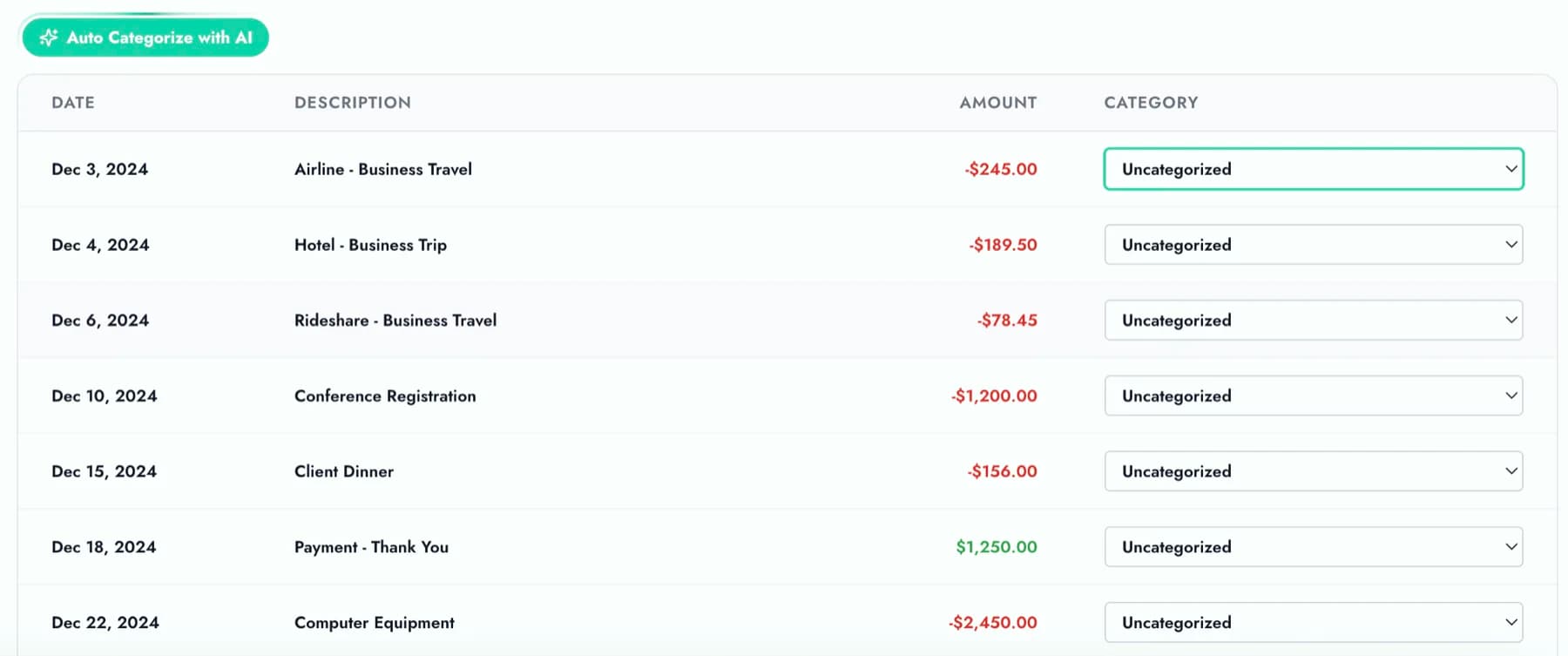
AI categorization
Every line is matched to the client chart of accounts using transaction context, not a vendor lookup table. The model learns from each correction at the vendor level for that client.
Double-entry posting
Approved batches post as balanced journal entries. Trial balance refreshes the same moment. No CSV gymnastics. No reformatting for a different tool.
Multi-client dashboard
Every client lives on one screen. Filter by status, overdue requests, or open exceptions. Switch context without losing where you were.
Client portal that works
A single link lets clients upload PDFs, photos, or scans. They never see Zera Books unless you brand it for them.
AI reporting suite
P&L, Balance Sheet, Cash Flow, AR Aging, AP Aging, Trial Balance, and a written variance summary. Ready for the advisory meeting.
Audit trail on every event
Every AI suggestion stores its confidence score, the source document, who approved it, and when. Pulls satisfy AICPA and IRS recordkeeping standards.
Real-time close
Most firms shave 3 to 5 days off their close cycle inside the first month. Some Zera firms run a continuous close and never wait for month-end at all.
Pricing, in plain English
Zera Books is $79 per month flat. Unlimited clients, unlimited documents, unlimited staff seats. One credit card, one number. The trial is one week with no card required. That is it.
For context, QuickBooks Online runs $35 to $235 per client per month plus per-seat add-ons on the Intuit pricing page. Pilot starts at $499 a month per client. Bench starts at $299. Botkeeper bills per client. Run the math at 20 clients and the gap is not small.
Who runs on an AI accountant
Six firm shapes that get the most leverage from Zera Books today.
Coming from QuickBooks or Xero?
Most firms keep QBO or Xero as the system of record on day one and use Zera as the AI bookkeeping layer underneath. Export to QBO and IIF, push journal entries through the native sync, leave the tax workflow exactly where it is. When the firm is ready, the GL moves over. Full playbook in the QuickBooks alternative guide.
My firm went from 38 clients to 94 in one year without adding staff. The AI handles every bank statement and invoice on the first pass. I review, I sign, I bill. The data entry layer is gone.
Frequently asked questions
What is an AI accountant?
An AI accountant is software that performs the data-entry and classification work of bookkeeping using large language models and machine learning. It reads source documents, codes transactions against a chart of accounts, and posts double-entry journal entries. It does not replace the judgment work a CPA owns: tax planning, attest, advisory, or sign-off.
Will AI replace accountants?
No. AI replaces the lower-margin parts of the job. The BLS still projects 4% growth in accountant employment through 2032. Firms that adopt AI accountants serve 2 to 3 times more clients per staff member and reinvest the freed hours into advisory work.
Do I still need a CPA if I use an AI accountant?
For most growing businesses, yes. A CPA still signs off on tax filings, handles IRS correspondence, advises on entity structure, and runs attest work. The AI handles the bookkeeping layer underneath that. Think of it as a junior staff accountant that never sleeps.
How accurate is an AI accountant?
Zera Books reports 99.6% field-level accuracy on document extraction across 3.2 million processed documents. Categorization starts around 85% on day one and climbs above 95% within 30 days as the model learns vendor patterns per client.
How much does an AI accountant cost?
Zera Books is $79 per month flat with unlimited clients and documents. Botkeeper starts around $69 per client per month. Pilot starts at $499. Bench starts at $299. Keeper is roughly $8 to $12 per client per month for the review layer, on top of your existing GL.
Is an AI accountant safe for audited financials?
Yes when the platform keeps a full audit trail. Zera Books logs every AI suggestion, every override, source document, timestamp, and the human who approved each posting. The IRS and AICPA accept AI-generated books as long as the underlying records are preserved.
Can ChatGPT do my bookkeeping?
Not at the firm level. ChatGPT can answer questions about accounting, but it has no ledger, no double-entry engine, no audit trail, and no integration with your bank. A purpose-built AI accountant like Zera Books does have all of those layers.
Does an AI accountant work with QuickBooks or Xero?
Yes. Zera Books exports to QBO and IIF, and pushes journal entries into QuickBooks Online and Xero through native sync. You can run AI bookkeeping in Zera while keeping QBO or Xero as the system of record.
What jobs in accounting will AI actually take?
Pure data-entry roles, statement converter operators, and most rules-based categorization work shrink fast. Tax, audit, controllership, advisory, FP&A, and CFO services grow. The AICPA pipeline report flags this shift directly.
Can an AI accountant handle multi-client work?
Yes. Zera Books was built for firms managing 50+ clients from a single dashboard. Each client has isolated books, isolated learning, isolated reports, and isolated permissions for staff and reviewers.
How fast can a firm onboard a client with an AI accountant?
A typical SMB client with 12 months of backlog gets caught up inside one week using Zera Books. Document collection runs through the portal, the AI processes statements in minutes, and the first close runs the same day.
What does an AI accountant cost a firm compared to a junior hire?
A junior bookkeeper in the US costs roughly $55,000 fully loaded. Zera Books is $948 a year. The math is brutal. The point is not headcount cuts, it is leverage: the same headcount serving 3x the client base.
Related guides in the AI Accountant cluster
Every page below answers a different slice of the AI accountant question. Bookmark the ones your firm faces this quarter.
Honest answers
Firm playbooks
Head to heads
Ready to run on an AI accountant?
One platform, every client, 99.6% extraction accuracy, $79 flat. The trial runs one week and asks for no credit card.